What Is Retirement Coordination—and Why Does It Matter?
Retirement coordination is the ongoing process of evaluating spending, income, taxes, and investments together rather than as separate financial decisions.
The idea is straightforward: a decision in one area of retirement often changes what makes sense somewhere else. Retirement coordination provides a structure for considering those interactions in the right sequence and revisiting them as circumstances change.
At Mark Sharp Retirement, that sequence is:
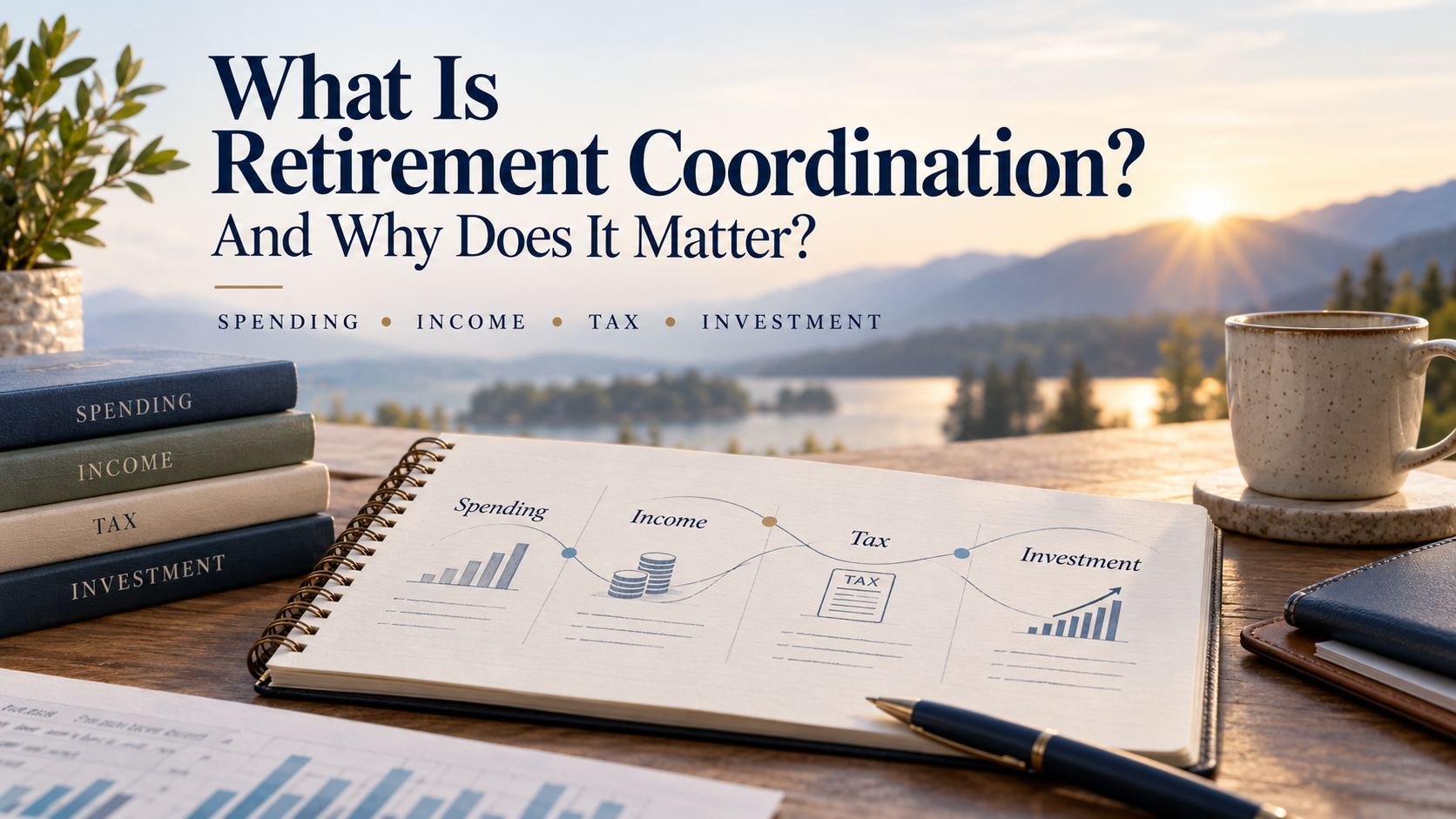
Spending → Income → Tax → Investment
The framework provides the structure. An ongoing advisory relationship is how that structure is put into practice over time.
What Does Retirement Coordination Mean?
Retirement creates a different set of financial decisions than the accumulation years.
Instead of primarily deciding how much to save and how to invest it, retirees have to determine how accumulated resources will actually be used.
How much can reasonably be spent?
Where should income come from?
When should Social Security begin?
Which accounts should fund withdrawals?
When might Roth conversions make sense?
How should investments be positioned when some of the portfolio may need to support spending?
These questions may appear separate. They are not.
A withdrawal decision can affect taxes. Taxes can affect Medicare premiums. The timing of Social Security can change how much needs to come from investments. Spending changes can alter withdrawal needs and the responsibilities assigned to the portfolio.
Retirement coordination means evaluating those decisions in relation to one another.
Why Does the Sequence Matter?
The Retirement Coordination Framework™ starts with spending because the resources have to support something.
Spending
Spending establishes how much the household needs and when those resources may be needed.
Without that starting point, it is difficult to determine how much income must be generated or what the investment portfolio is expected to accomplish.
Income
Once the spending requirement is understood, the next question is how it will be supported.
Income may come from Social Security, pensions, portfolio withdrawals, required minimum distributions, cash reserves, or other sources.
The mix and timing of those resources influence what comes next.
Tax
Different sources of income can produce different tax consequences.
An IRA withdrawal is not taxed the same way as a qualified Roth distribution. Selling investments from a taxable account may create capital gains. Additional income can affect the taxation of Social Security or Medicare premiums.
Tax considerations therefore influence which resources are used and when.
Investment
Only after those responsibilities are clearer can investments be evaluated in context.
The question is not simply how a portfolio should be invested in the abstract.
The question is what the assets are responsible for supporting, when they may be needed, and how much uncertainty the retirement structure can reasonably absorb.
Each step gives the next step something to solve.
Why Should Retirement Decisions Be Evaluated Together?
Consider a common retirement question:
Should I complete a Roth conversion this year?
Viewed only through the federal tax brackets, the analysis might appear relatively simple. Determine the available room in a desired bracket and decide how much to convert.
But the conversion may affect other parts of the retirement structure.
It could influence Medicare premiums in a future year. It could change how other income is taxed. The taxes due on the conversion have to be paid from somewhere. And converting assets from a traditional IRA to a Roth changes the location and future tax characteristics of investment resources.
The Roth conversion is therefore not just a tax decision.
Or consider Social Security.
Delaying benefits may result in a larger future benefit. But delaying also means spending must be supported by other resources in the meantime. That can change portfolio withdrawals, taxes, and investment responsibilities.
Neither decision can be fully evaluated without understanding what it affects next.
That is the coordination problem.
Why Does Retirement Coordination Need to Continue Over Time?
Even when the initial retirement structure is well thought out, the underlying circumstances do not remain fixed.
Spending changes.
Social Security begins.
A pension may start.
Roth conversion opportunities may narrow.
Required minimum distributions eventually begin.
Tax laws change.
Investment markets move.
Healthcare expenses can increase.
Charitable priorities may change.
A spouse may die.
Housing needs may change.
Those developments can alter decisions elsewhere in the retirement structure.
A withdrawal approach that made sense several years ago may need to change once required distributions begin. An investment allocation may need to be reconsidered if spending changes materially. A tax decision may look different after Social Security starts or following the death of a spouse.
Retirement coordination therefore is not something completed when retirement begins.
It is a process of carrying earlier decisions forward, incorporating new information, and deciding whether adjustments are warranted.
Can Retirement Coordination Be Done Through a One-Time Plan?
A one-time retirement analysis can be useful for answering a defined question or evaluating circumstances at a particular point in time.
Its limitation is not necessarily the quality of the analysis.
The limitation is that the engagement ends while the retirement decisions continue.
A projection prepared today can use reasonable assumptions about future spending, taxes, markets, and income. But actual experience will eventually replace those assumptions.
The retiree then faces another decision.
And another.
Each new decision needs to be considered in the context of what has happened since the original analysis and what earlier decisions have already put in motion.
That is where the distinction between one-time planning and ongoing retirement coordination becomes important.
Why Does an Ongoing Advisory Relationship Fit Retirement Coordination?
An ongoing advisory relationship provides continuity between retirement decisions.
Instead of approaching each question as though it were a new problem, the advisor can consider what has already been decided, what has changed, and what decisions are likely to come next.
That continuity matters.
A Roth conversion completed this year can be evaluated again when the next tax projection is prepared.
A spending change can be considered alongside portfolio withdrawals and investment positioning.
A Social Security decision can be incorporated into the income structure once benefits begin.
A tax return can be reviewed not merely as a record of the prior year, but as information for current-year decisions.
The ongoing relationship creates a process for connecting those decisions across time.
Does Ongoing Advice Mean Constantly Making Changes?
No.
Ongoing retirement coordination does not mean that something needs to change every month or every quarter.
Often the appropriate decision is to continue with the existing structure.
The purpose of an ongoing process is to create regular opportunities to determine what has changed, what requires attention, and what can reasonably be left alone.
Some decisions need attention early in the year. Others become more relevant after tax returns are completed. Still others need to be addressed before year-end.
The work is therefore structured around when decisions become relevant rather than trying to reconsider everything at once.
What Does Ongoing Retirement Coordination Look Like?
At Mark Sharp Retirement, ongoing coordination follows a defined annual planning rhythm.
Different points during the year are used to evaluate different parts of the retirement structure.
Prior-year tax results can inform current income and tax decisions.
Spending and income can be reviewed against what is actually occurring.
Investment responsibilities can be reconsidered when withdrawals, markets, or household circumstances change.
Later in the year, Roth conversions, required distributions, charitable giving, withholding, and other year-end decisions can be evaluated with more complete information.
Each review builds on the decisions that came before it.
That is different from repeatedly producing a new plan.
The objective is to maintain continuity across retirement decisions as the facts change.
The Framework and the Relationship Serve Different Purposes
The Retirement Coordination Framework™ provides a way to think about retirement decisions:
Spending → Income → Tax → Investment
But a framework by itself does not make the decisions.
Putting it into practice requires periodically revisiting the underlying information, evaluating what has changed, and carrying prior decisions forward.
That is why Mark Sharp Retirement is structured around an ongoing advisory relationship rather than hourly consultations or standalone planning engagements.
Retirement does not present one financial question that can be solved once.
It presents a series of connected decisions that unfold over time.
Retirement coordination is the process for keeping those decisions connected.