
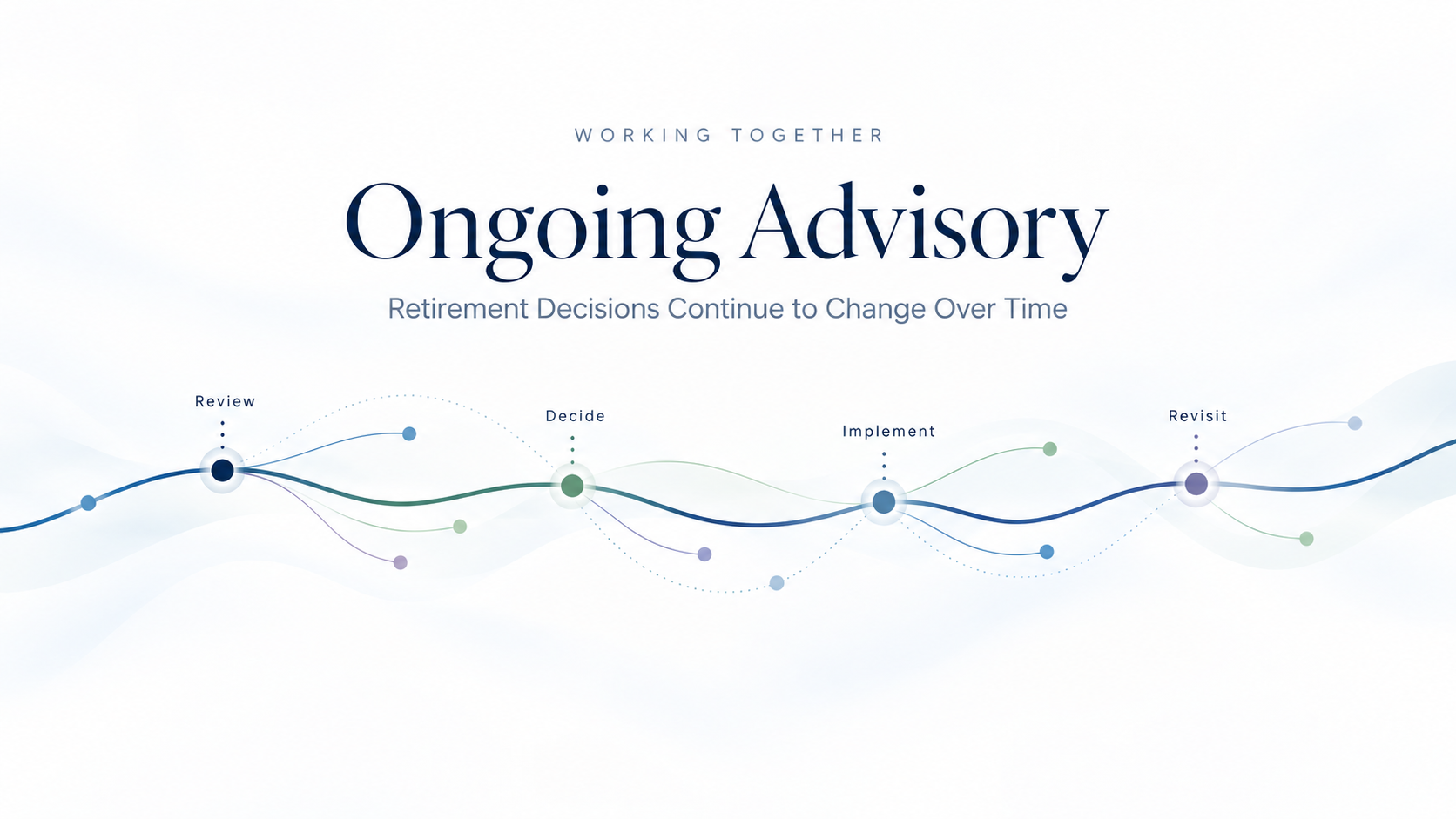
Retirement Decisions Continue to Change Over Time
Some retirement decisions require attention now. Others become relevant years later.
Spending changes. Income sources begin and end. Tax opportunities and constraints shift. Required minimum distributions eventually begin. Markets change, and decisions made earlier may need to be revisited.
Our ongoing advisory relationship provides a structure for deciding what needs attention, carrying those decisions forward, and adjusting as circumstances change.
Different Decisions Matter at Different Times
The decisions that matter early in retirement are not always the ones that matter later.
Early retirement may involve establishing a sustainable spending level, deciding where portfolio withdrawals should come from, and determining when Social Security should begin.
Later, attention may shift to Roth conversions, Medicare-related income thresholds, required minimum distributions, charitable giving, changes in spending, or planning for a surviving spouse.
The work changes as retirement changes. The ongoing relationship provides a structure for identifying which decisions require attention now, understanding the tradeoffs, and revisiting earlier decisions when new circumstances affect them.
Who the Ongoing Advisory Relationship Is For
This service is designed for people approaching retirement or already retired who want more than a one-time analysis.
It may be a good fit if you:
- Expect retirement decisions to continue changing over time
- Want help deciding what needs attention now and what can wait
- Prefer income, tax, spending, and investment decisions to be evaluated together
- Value on ongoing relationship in which prior decisions are revisited as circumstances change
- Want support carrying recommendations through rather than simply receiving them
What’s Included in the Ongoing Advisory Relationship
Ongoing retirement coordination brings the decisions we have identified into a recurring process of review, implementation, and adjustment.
Select a section below to learn more about the ongoing advisory relationship.
- Review changes in your spending, income, taxes, investments, and household circumstances
- Identify decisions that require attention and determine what can wait
- Revisit prior decisions when circumstances or priorities change
- Carry agreed-upon actions forward and review their effect on other retirement decisions
- Address time-sensitive matters through the annual planning rhythm
- Review actual spending in relation to available retirement resources
- Establish and update spending guardrails as circumstances and markets change
- Coordinate Social Security, pensions, cash reserves, and portfolio withdrawals
- Determine which resources should provide income and when
- Adjust income decisions as spending needs and other sources of income change
- Prepare annual tax projections when appropriate
- Evaluate Roth conversions, withdrawals, capital gains, and other income decisions across multiple years
- Consider Medicare-related income thresholds, required minimum distributions, charitable giving, and other tax-related constraints
- Review completed tax returns for information that may affect current or future decisions
- Coordinate relevant planning decisions with your tax preparer when appropriate
- Align investment positioning with the spending and income responsibilities the portfolio is expected to support
- Review portfolio allocation, construction, and rebalancing needs
- Coordinate investment decisions with withdrawal and tax planning
- Evaluate investment decisions in relation to withdrawals and tax considerations
- Implement investment recommendations through advisor-managed accounts or support client-directed implementation, depending on your preference
Some clients prefer to delegate investment implementation, while others prefer to manage their own accounts. Either approach can be incorporated into the ongoing advisory relationship. In both cases, investment decisions remain part of the broader retirement coordination process.
Annual Advisory Fee
The ongoing advisory relationship begins at $7,500 per year.
Fees may increase as the amount and complexity of retirement resources increase. As a general guideline, the annual fee typically increases by approximately $1,250 for each additional $1 million of investable assets.
The scope of the relationship remains consistent. Fee differences reflect the amount of ongoing coordination required rather than access to different levels of service.
Investment Implementation
Investment planning is part of the ongoing advisory relationship.
If you prefer to delegate implementation, we can manage the accounts for which we have investment authority. Portfolio management is included in the annual advisory fee and is not subject to a separate asset-based management fee.
If you prefer to manage your own accounts, we can provide investment recommendations for you to implement.
In either arrangement, investment decisions are evaluated in relation to the spending, income, and tax responsibilities those assets are expected to support.
How You’ll Get Started
All new clients begin with the Foundational Coordination Phase, a focused 60–90-day process designed to understand how your retirement resources are currently structured, identify the decisions that require attention first, and establish the initial direction for spending, income, taxes, and investments.
Once that foundation is in place, the relationship transitions into the ongoing annual planning rhythm, where decisions are revisited, implemented, and adjusted as circumstances change. Meeting requests are reviewed before an appointment is confirmed.