Retirement Is a Coordination Process
Retirement decisions become easier to evaluate when they are addressed in the right sequence.
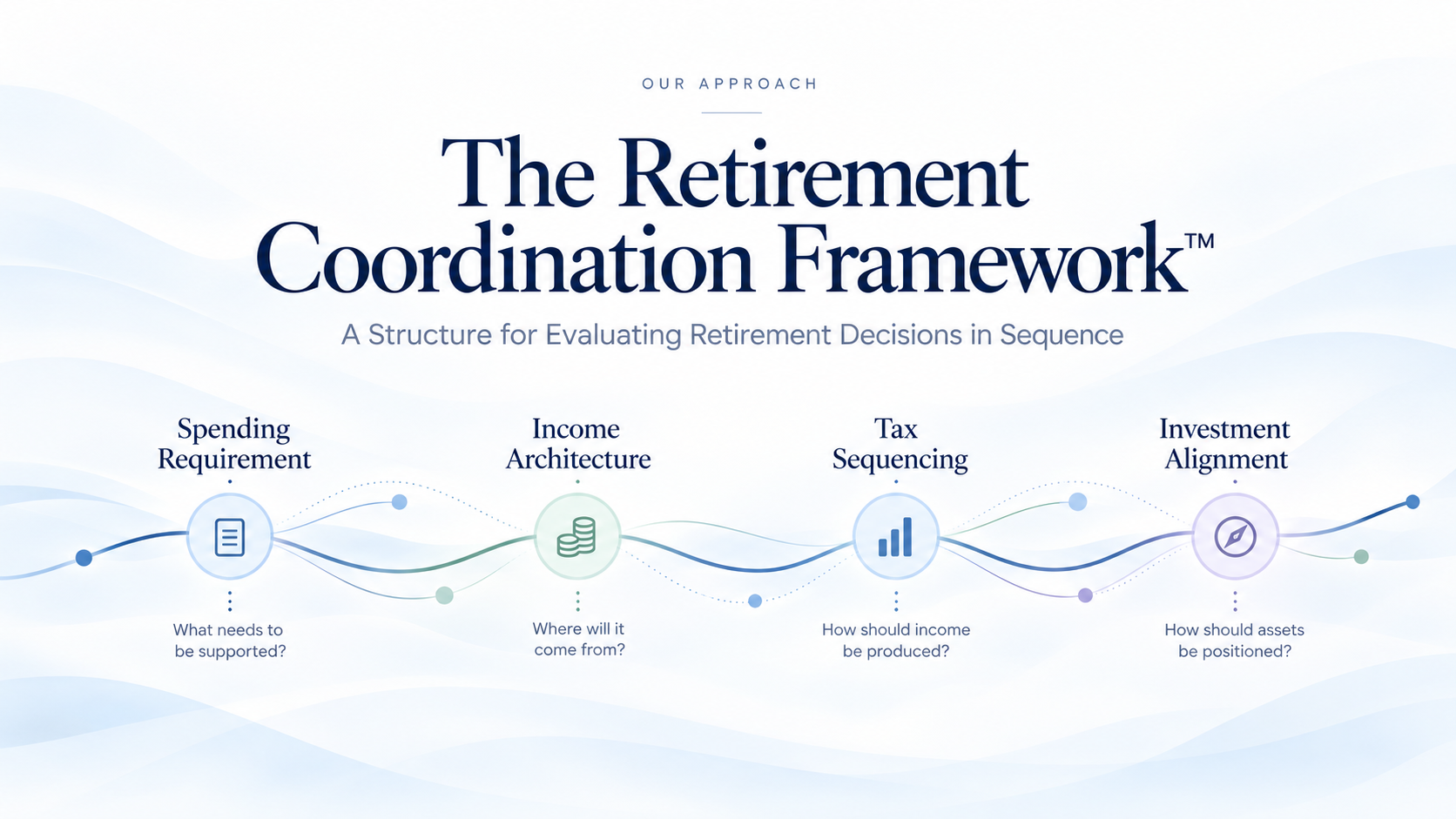
The Retirement Coordination Framework™ begins with what your resources need to support, then works through income, tax, and investment decisions in that order.
Spending → Income → Tax → Investment
Each step provides context for the next.
This framework guides how we work with clients through an ongoing advisory relationship. You may arrive with a specific question, such as when to begin Social Security. We address that question by first understanding your spending needs, then evaluating income, taxes, and investments together.
The decision becomes part of the retirement structure we continue to review and adjust over time. The firm does not offer hourly consultations or standalone project engagements.
Why the Sequence Matters
Retirement decisions are often considered one at a time. Spending may be evaluated separately from income, tax decisions may be made one year at a time, and investments may be reviewed without enough context about when assets will be needed.
Each decision may be reasonable on its own. The challenge is understanding what it affects next.
Withdrawals can affect taxes and Medicare premiums. Tax decisions can affect future flexibility. Spending can move out of alignment with available resources. Investment decisions can expose near-term withdrawals to risks the portfolio was not structured to support.
The Retirement Coordination Framework™ provides a structure for evaluating these decisions in sequence and revisiting them as circumstances change.
- Spending Requirement
- Income Architecture
- Tax Sequencing
- Investment Alignment
The Retirement Coordination Framework™

1. Spending Requirement
What needs to be supported?
Spending establishes what your retirement resources need to support.
Before determining how much income the portfolio should provide or how assets should be invested, we first need to understand the household's expected spending—including ongoing living expenses and larger or less frequent needs that may arise throughout retirement.
Once the spending requirement is understood, the remaining retirement resources can be evaluated in relation to that responsibility.
Spending establishes what needs to be supported.
2. Income Architecture
Where will it come from?
Income Architecture translates the spending requirement into a practical income structure.
Once spending has been established, the next question becomes:
Which retirement resources should provide that income, when should they be used, and how should they work together over time?
Income sources may include:
- Social Security, pensions, and other dependable income
- Portfolio withdrawals
- Cash reserves
- Annuity or other contractual income, when applicable
- The sequencing and timing of those income sources
The objective is not simply to generate income. It is to coordinate available resources around the spending requirement while preserving flexibility for future decisions.
Income determines how spending will be funded.
3. Tax Sequencing
How should income be produced?
We evaluate the tax consequences and timing of decisions involving:
- Social Security taxation
- IRA and other tax-deferred account withdrawals
- Roth conversions
- Capital gains realization
- Required minimum distributions
- Medicare-related income thresholds
- Charitable giving
- Multi-year tax bracket considerations
The objective is not to minimize taxes in a particular year. A decision that lowers taxes today can sometimes reduce flexibility or create less favorable choices later.
Instead, tax decisions are evaluated in relation to current spending needs, future income, and the resources available across accounts.
Tax Sequencing determines how income should be produced over time.
4. Investment Alignment
How should assets be positioned?
Investments support the retirement structure. They do not define it.
Once the spending requirement, income structure, and tax considerations have been established, the remaining question becomes:
What responsibilities should individual accounts and investment resources serve?
Some resources may need to support near-term spending. Others may primarily support spending many years from now or provide flexibility for changing circumstances.
Those responsibilities help inform decisions about:
- Asset allocation
- Risk exposure
- Diversification
- Rebalancing
- Asset location
- Liquidity
Investment decisions are therefore made in relation to the responsibilities each resource is expected to fulfill.
Investment Alignment determines how assets should be positioned for those responsibilities.
Coordination Continues Over Time
The framework is not a one-time sequence completed at retirement.
Spending changes. Income sources begin and end. Tax laws and Medicare-related thresholds can shift. Required minimum distributions begin. Markets move, and investment responsibilities may change as assets are used.
When circumstances change, the same sequence can be revisited:
Spending → Income → Tax → Investment
A change in spending may alter the amount of income needed. A change in income may affect taxes. Tax consequences may influence which accounts are used. Those decisions may change how investments should be positioned.
The framework provides a consistent way to work through those changes without treating each new retirement question as an isolated decision.
A Structure for Ongoing Decisions
The Retirement Coordination Framework™ provides a consistent way to evaluate retirement decisions as circumstances change.
The objective is not to make every decision at once or assume there is a single correct answer. It is to understand the tradeoffs, identify what each decision may affect next, and adjust as new information emerges.
The same structure can be revisited throughout retirement as spending, income, taxes, and investment responsibilities change.
Meeting requests are reviewed before an appointment is confirmed.
REQUEST AN INTRODUCTORY MEETING