Investment Alignment
The Fourth Pillar of the Retirement Coordination Framework
An investment alignment strategy positions retirement assets according to the responsibilities they are expected to fulfill and serves as the final step in coordinating spending, income, taxes, and investments over time. Within the Retirement Coordination Framework, Investment Alignment is the fourth of four interconnected pillars because how retirement assets are invested should follow from the decisions those assets are intended to support.
Retirement planning often begins with investments.
The Retirement Coordination Framework ends with investments.
This difference is intentional. Before deciding how retirement assets should be positioned, it is important to understand how much spending they need to support, what income will be available, and which accounts and income sources may be used at different times.
The sequence provides a clear decision structure:
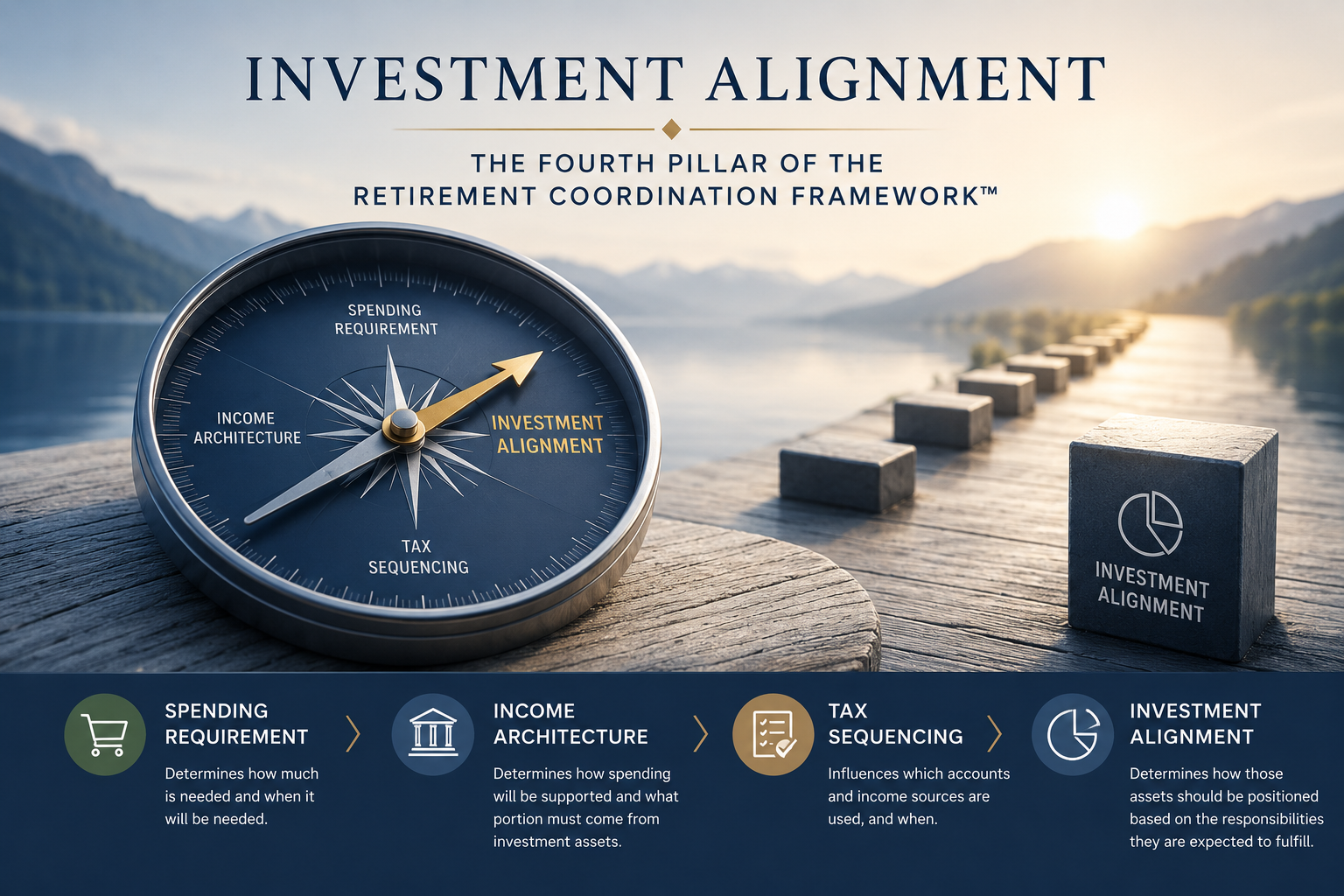
Spending Requirement determines how much is needed and when it will be needed.
Income Architecture determines how spending will be supported and what portion must come from investment assets.
Tax Sequencing influences which accounts and income sources are used, and when.
Investment Alignment determines how those assets should be positioned based on the responsibilities they are expected to fulfill.
When investments come last, portfolio decisions can be evaluated in the context of the retirement decisions they are intended to support rather than considered independently.
Why Investments Come Last
Investment Alignment does not mean investments are less important.
It means that the role of the portfolio becomes clearer after the decisions that precede it have been considered.
Two retirees can have the same portfolio balance and similar tolerance for investment risk but require different investment structures.
One may need substantial portfolio withdrawals during the first several years of retirement while delaying Social Security. Another may have a pension and Social Security covering most current spending and may not need meaningful portfolio withdrawals for years.
The portfolio values may be identical.
The responsibilities of those assets are not.
Understanding those responsibilities provides context for decisions about liquidity, stability, growth, and investment risk.
How the Other Three Pillars Influence Investment Alignment
Spending Requirement
Spending establishes how much the household needs and when those resources are likely to be required. Assets expected to support near-term spending may carry a different responsibility from assets intended to support spending much later in retirement.
Income Architecture
Social Security, pensions, annuities, portfolio withdrawals, and other income sources work together to support spending. Income Architecture helps determine how much of that spending must come from investment assets and when those withdrawals are expected to occur.
Tax Sequencing
The account used to fund spending can matter as much as the amount withdrawn. Traditional IRAs, Roth IRAs, and taxable accounts have different tax characteristics. Roth conversions, Required Minimum Distributions, capital gains, and Medicare premium surcharges can also influence which assets may be used at different times.
Investment Alignment brings these preceding decisions into the portfolio by positioning assets around the responsibilities they are expected to fulfill.
Every Retirement Dollar Does Not Have the Same Responsibility
Retirement assets often serve different purposes.
Some may be expected to support spending within the next few years. Other assets may remain invested for considerably longer. Certain accounts may play a role in planned Roth conversions or future Required Minimum Distributions. Still others may ultimately support later-life spending or legacy goals.
These differences matter because an asset's responsibility can influence how much liquidity, stability, or long-term growth it requires.
This does not mean every future expense needs its own investment account or that retirement assets must be divided into rigid time-based buckets.
Time horizon matters, but it is only one consideration.
The responsibility of an asset can also depend on the spending it supports, the income available at the time, the type of account holding the asset, and the tax consequences of accessing it.
Investment Alignment Changes Over Time
Retirement does not remain static, and neither do the responsibilities assigned to investment assets.
Social Security may begin. A pension may start. Roth conversions may end. Required Minimum Distributions eventually become part of household income. Spending may change. A large purchase may temporarily increase the need for liquidity.
As these circumstances change, the responsibility of different assets may change as well.
Investment Alignment is therefore not about selecting an allocation at retirement and assuming it will remain appropriate indefinitely.
It is an ongoing process of evaluating whether the investment structure continues to support the household's spending, income, and tax decisions.
Explore Investment Alignment
The following articles explore the key ideas behind retirement investment decisions and how they fit within the Retirement Coordination Framework.
How Should You Invest Your Portfolio in Retirement?
Start here.
Learn why deciding how to invest in retirement begins with understanding what your assets are responsible for—and why this differs from simply dividing a portfolio into time-based buckets.
→ Read: How Should You Invest Your Portfolio in Retirement?
What Is Sequence of Returns Risk in Retirement?
Understand why the timing of market declines matters when portfolio withdrawals are occurring and how withdrawal needs can change the consequences of investment risk.
→ Read: What Is Sequence of Returns Risk in Retirement?
How to Turn Your Portfolio Into a Paycheck
Explore how investment assets can work alongside Social Security, pensions, and other income sources to support retirement spending.
→ Read: How to Turn Your Portfolio Into a Paycheck
Why Your Retirement Portfolio Shouldn't Be Managed in Isolation
Learn why a reasonable investment allocation can still be poorly aligned with retirement when spending, income, withdrawal timing, and taxes are considered separately.
→ Read: Why Your Retirement Portfolio Shouldn't Be Managed in Isolation
Investments Support the Decisions That Come Before Them
Retirement investment decisions rarely exist in isolation.
Spending determines what is needed and when. Income determines how those needs will be supported. Tax Sequencing influences which resources are used and when. Investment Alignment positions those resources according to the responsibilities they are expected to fulfill.
That is why Investment Alignment serves as the fourth pillar of the Retirement Coordination Framework.
Rather than beginning with, "How should I invest my retirement portfolio?" the framework first answers three questions:
What do we need?
Where will it come from?
In what order should we access it?
Only then do we ask:
How should the assets supporting those decisions be positioned?
The result is an investment structure built around the retirement decisions the portfolio is responsible for supporting.
Return to the Retirement Coordination Framework
Investment Alignment completes the four-pillar sequence. The broader framework brings Spending Requirement, Income Architecture, Tax Sequencing, and Investment Alignment together so that decisions can be evaluated as part of the same retirement structure.