
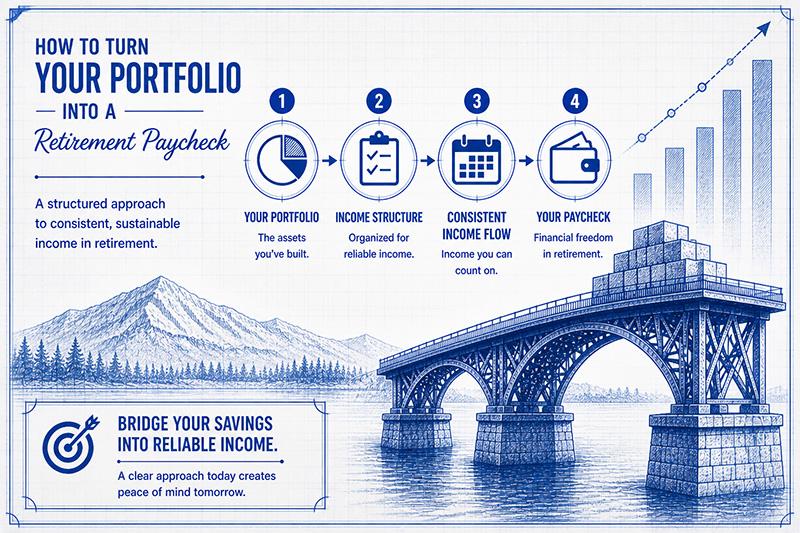
How to Turn Your Portfolio Into a Paycheck
How Do You Turn a Portfolio Into Income? (Quick Answer)
- By structuring assets into income roles
- Not by withdrawing randomly or evenly
Why a Portfolio Doesn’t Automatically Create Income
- Market fluctuations
- No built-in income structure
- Withdrawals require coordination
This is where a structured approach like Income Architecture in Retirement: How to Build a Reliable Paycheck for Life becomes essential.
The Shift From Accumulation to Income
Accumulation Mindset
- Growth-focused
Income Mindset
- Cash flow focused
- Sustainability matters
Step 1 – Assign Roles to Your Assets
Instead of relying on one pool of assets, income can be organized into distinct layers, each with a defined role—an approach explained in The 3 Layers of Retirement Income.
Step 2 – Create a Consistent Cash Flow Structure
Matching Income to Expenses
- Stability for needs
- Flexibility for wants
Avoiding Random Withdrawals
- Reduces exposure to volatility
Step 3 – Incorporate Predictable & Structured Income
Some approaches include incorporating income sources designed to provide more predictable and structured cash flow, particularly for essential expenses. This role is explored further in The Role of Predictable and Structured Income in Retirement.
Step 4 – Allow Remaining Assets to Work Long-Term
- Growth positioning
- Inflation offset
Common Mistakes When Creating Income
- Treating the portfolio as one pool
- Ignoring timing risk
- Over-withdrawing early
Conclusion
Turning a portfolio into income requires structure—aligning resources with purpose to create consistency and flexibility.