Why Your Retirement Portfolio Shouldn’t Be Managed in Isolation
A retirement portfolio can be well diversified, appropriately allocated, and reasonably matched to your tolerance for risk—and still be poorly aligned with your retirement.
That is because a portfolio does not tell us what the money needs to accomplish.
It does not tell us how much you plan to spend, when Social Security will begin, how much income a pension will provide, which accounts will fund withdrawals, whether Roth conversions are planned, or how those decisions may change over time.
Those questions exist outside the portfolio, but they directly affect how the portfolio should be managed.
Within the Retirement Coordination Framework, this is why Investment Alignment comes last.
Investment decisions should support the retirement decisions that come before them.
A Good Portfolio Is Not the Same as a Coordinated Retirement Strategy
Traditional investment questions remain important in retirement.
How much risk should you take?
How should the portfolio be diversified?
How much should be invested in stocks and bonds?
How often should the portfolio be rebalanced?
But those questions primarily tell us about the portfolio itself.
Retirement introduces another set of questions:
- How much spending must the portfolio support?
- When will withdrawals begin?
- How will those withdrawals change as other income sources begin?
- Which accounts will provide the money?
- How will withdrawals affect taxes?
- Which assets may not be needed for many years?
Without those answers, it is difficult to know whether an otherwise reasonable portfolio is aligned with the retirement it is expected to support.
Start With Spending, Not Investments
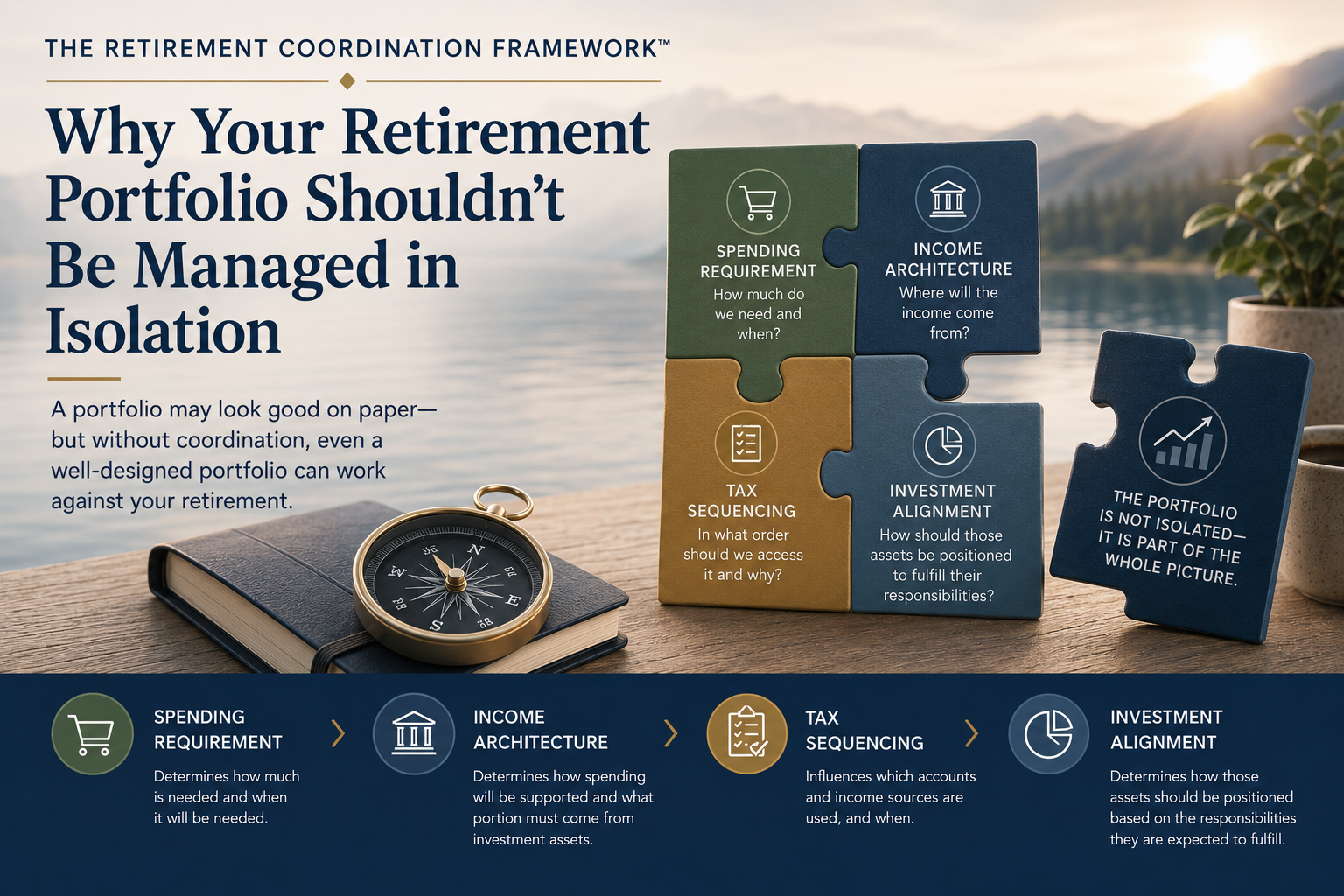
The Retirement Coordination Framework follows a specific sequence for a reason.
Spending Requirement determines how much is needed and when it will be needed.
Income Architecture determines how spending will be supported and what portion must come from investment assets.
Tax Sequencing influences which accounts and income sources are used, and when.
Investment Alignment determines how those assets should be positioned based on the responsibilities they are expected to fulfill.
Each decision gives the next one additional context.
Consider a household that needs $120,000 per year to support its retirement spending.
That number alone does not tell us how much the portfolio needs to provide.
Social Security may cover part of the spending. A pension may cover another portion. Those income sources may also begin at different times.
The portfolio is responsible for whatever remains.
Until that responsibility is understood, deciding how the portfolio should be positioned starts with incomplete information.
Income Timing Changes the Portfolio’s Responsibility
Retirement income rarely begins all at once.
Someone might retire at 65, receive a pension immediately, and delay Social Security until 70.
During the years before Social Security begins, the portfolio may need to provide substantially more income.
Once Social Security starts, the portfolio's annual withdrawal responsibility may decline.
The investments did not change.
The job assigned to them did.
That distinction matters because a portfolio supporting significant near-term withdrawals faces different demands from one that can remain largely untouched for several years.
This is one reason Income Architecture should be considered before determining how retirement assets are positioned.
Taxes Can Change Which Assets You Want to Use
Knowing that the portfolio must provide $40,000 does not necessarily tell you where that $40,000 should come from.
A retiree might have money available in:
- A taxable brokerage account
- A traditional IRA
- A Roth IRA
- Cash reserves
- An employer retirement plan
Each source can have different tax consequences.
A traditional IRA withdrawal generally creates taxable income. Selling investments in a taxable account may create capital gains. Qualified Roth IRA withdrawals generally do not increase taxable income.
Those differences can affect more than the current year's tax bill.
Withdrawals and Roth conversions can influence the taxation of Social Security, future Required Minimum Distributions, and Medicare income-related premium surcharges.
That is why Tax Sequencing comes before Investment Alignment.
If an account is expected to provide withdrawals at a particular point in retirement, that responsibility should be considered when determining how the assets within that account are invested.
Market Risk and Withdrawal Risk Are Connected
Market declines affect every investor.
But they can affect retirees differently when portfolio withdrawals are occurring at the same time.
Imagine two retirees with identical portfolios and identical investment allocations.
One needs substantial withdrawals from the portfolio during the next three years.
The other receives enough income from Social Security and a pension that no portfolio withdrawals are expected for several years.
If markets decline significantly, both portfolios may fall by a similar percentage.
But the consequences may be very different.
The first retiree may need to sell investments while values are depressed. The second may have more time to wait for markets to recover.
This is the practical significance of sequence of returns risk.
Investment risk cannot be fully understood without knowing when the portfolio is expected to provide money.
A Retirement Portfolio Can Have More Than One Responsibility
The portfolio itself may not have a single job.
Some assets may be responsible for supporting spending during the first several years of retirement.
Other assets may support spending much later.
A traditional IRA may be affected by future Required Minimum Distributions. A Roth IRA may have a longer time horizon because current spending can be supported from other resources. Taxable assets may provide flexibility during the years between retirement and Social Security.
This does not require dividing the portfolio into rigid time-based buckets.
As discussed in How Should You Invest Your Portfolio in Retirement?, Investment Alignment considers time horizon along with spending responsibility, income availability, account type, tax consequences, and how those factors may change.
The objective is not to create more investment categories.
It is to understand what different retirement resources are being asked to accomplish.
The Portfolio’s Responsibilities Change Over Time
One of the limitations of treating investment management as a separate retirement activity is the assumption that an appropriate portfolio today will necessarily remain appropriate later.
Retirement circumstances change.
Social Security begins.
Roth conversions may end.
Required Minimum Distributions begin.
Spending changes.
A surviving spouse may eventually have a different income and tax structure.
A major purchase may create a temporary need for additional liquidity.
Each change can alter what the portfolio is responsible for supporting.
Investment Alignment therefore requires more than periodically returning the portfolio to a target allocation.
It requires asking whether the responsibilities assigned to the assets have changed—and whether the investment structure still reflects those responsibilities.
Investment Decisions Are the Result of Earlier Decisions
Retirement planning often begins by asking:
How should I invest my retirement portfolio?
The Retirement Coordination Framework approaches the question differently.
First:
What do we need?
That establishes the Spending Requirement.
Then:
Where will it come from?
That establishes the Income Architecture.
Next:
In what order should we access it?
That informs Tax Sequencing.
And finally:
How should the assets supporting those decisions be positioned?
That is Investment Alignment.
The portfolio remains important. But it is not a separate retirement strategy.
It is one part of a larger decision structure.
When investment decisions reflect spending needs, income timing, withdrawal decisions, taxes, and the changing responsibilities of retirement assets, the portfolio can do what it is ultimately there to do:
support the retirement decisions that came before it.