How Should You Invest Your Portfolio in Retirement?
A retirement portfolio should be invested based not only on your tolerance for risk, but also on what the assets are expected to do for you over time.
That makes investing in retirement different from investing while you are working.
During your working years, much of the portfolio may share a common purpose: accumulating resources for the future. Once you retire, those assets begin taking on different responsibilities. Some may need to support spending soon. Others may not be needed for many years. Different accounts may also play different roles in future withdrawals, Roth conversions, Required Minimum Distributions, or legacy goals.
So before asking how your retirement portfolio should be invested, there is another question to answer:
What is the money responsible for?
Within the Retirement Coordination Framework, this is the idea behind Investment Alignment.
Start With the Retirement Decisions the Portfolio Must Support
A retirement portfolio does not exist independently from the rest of retirement.
Before determining how assets should be positioned, it helps to work through the decisions that establish what the portfolio will be asked to do.
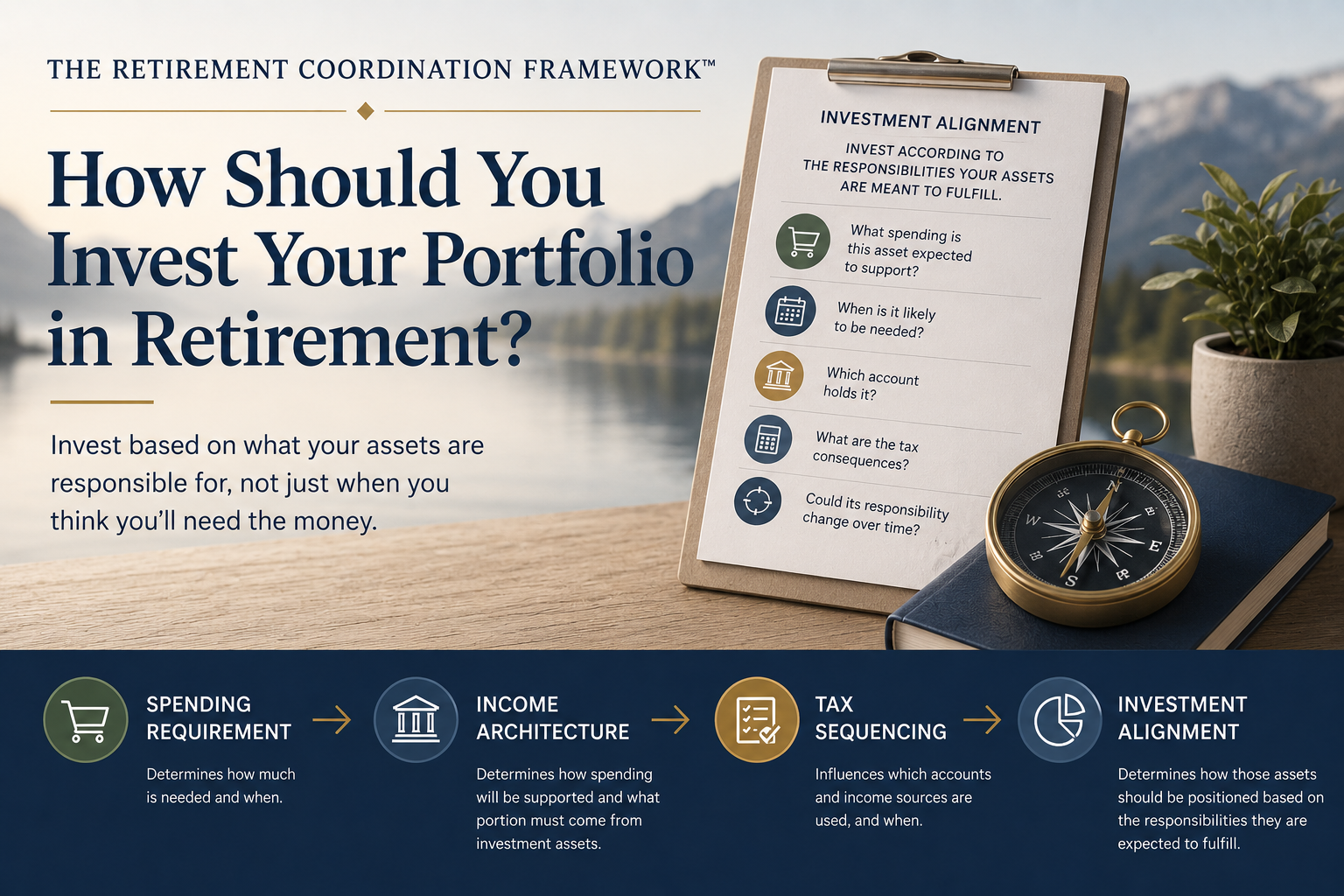
Spending Requirement determines how much is needed and when it will be needed.
Income Architecture determines how spending will be supported and what portion must come from investment assets.
Tax Sequencing influences which accounts and income sources are used, and when.
Investment Alignment determines how those assets should be positioned based on the responsibilities they are expected to fulfill.
This sequence changes the investment question.
Instead of beginning with:
What percentage should I have in stocks and bonds?
The process begins by determining what the portfolio needs to support.
Different Assets Can Have Different Responsibilities
Consider someone retiring at age 65 who plans to delay Social Security until age 70.
During those five years, pension income and other predictable income may cover only part of household spending. The portfolio may need to provide the difference.
Once Social Security begins, the amount required from the portfolio may decline substantially.
That creates at least two different responsibilities within the same retirement portfolio.
Assets expected to support the first several years of withdrawals need to account for the possibility that markets decline while the money is being spent.
Assets that are unlikely to be needed for many years have a longer time horizon and a different responsibility.
The same principle can extend across accounts.
A taxable account may be used to support early-retirement spending. A traditional IRA may eventually become a larger source of income as Required Minimum Distributions begin. Roth assets may remain invested longer because they are not currently needed for spending.
The appropriate investment structure depends partly on these responsibilities.
This Is Not Simply a Bucket Strategy
At first glance, assigning different responsibilities to retirement assets can sound like a traditional bucket strategy.
There is an important difference.
A bucket strategy generally divides retirement assets according to when the money is expected to be spent. A retiree might maintain one pool for near-term spending, another for intermediate needs, and another for long-term growth.
Investment Alignment considers time horizon, but it does not stop there.
It also considers:
- What spending is the asset expected to support?
- What other income will be available at that time?
- Which account holds the asset?
- What are the tax consequences of accessing that account?
- Could the asset be used as part of a Roth conversion strategy?
- When will Required Minimum Distributions affect the income structure?
- Is the asset likely to be spent at all?
- How might its responsibility change as retirement progresses?
Two assets with the same expected time horizon can therefore have different responsibilities.
And an asset's responsibility today may not be its responsibility ten years from now.
Investment Alignment is not about putting money into fixed buckets and waiting to spend each one. It is about coordinating the investment structure with the changing responsibilities of the household's retirement resources.
Time Horizon Still Matters
Distinguishing Investment Alignment from a bucket strategy does not make time horizon unimportant.
Money that may be needed next year generally cannot be treated the same way as money that is unlikely to be needed for fifteen years.
The difference is that time horizon is one input rather than the organizing principle for the entire portfolio.
This matters because retirement income does not usually remain constant.
Social Security may begin several years after retirement. A pension may start or change. Roth conversions may temporarily increase taxable income. Required Minimum Distributions eventually begin. Spending itself can change substantially over the course of retirement.
As those circumstances change, the amount and type of support required from the portfolio can change as well.
Risk Is About More Than How Much Volatility You Can Tolerate
Risk tolerance remains important in retirement, but it does not fully describe the risk a retiree faces.
Consider two retirees who are equally comfortable with market fluctuations.
One needs $60,000 from the portfolio over the next two years.
The other does not expect to make a withdrawal for ten years.
Their emotional tolerance for market risk may be identical, but their ability to absorb a significant market decline is not.
The first retiree faces the possibility of selling investments while values are depressed. The second may have substantially more time to allow the portfolio to recover.
This is one reason sequence of returns risk becomes particularly important once portfolio withdrawals begin.
Investment decisions should reflect not only how an investor feels about risk, but also the responsibilities the assets must fulfill if markets behave poorly.
Account Type Matters Too
Retirement assets are often spread across taxable accounts, traditional IRAs, Roth IRAs, and employer retirement plans.
Those accounts do not have identical tax characteristics.
A dollar withdrawn from a traditional IRA can have a different effect on taxable income than a dollar withdrawn from a Roth IRA or taxable brokerage account. Withdrawals can also interact with capital gains, Social Security taxation, Medicare premium surcharges, and other tax considerations.
That means deciding which account will provide future spending can influence how assets within that account should be positioned.
This is where Investment Alignment connects directly with Tax Sequencing.
The investment portfolio should support the withdrawal strategy rather than operate independently from it.
Responsibilities Can Change
Retirement can last several decades.
An investment structure established on the retirement date should not automatically be expected to serve the household indefinitely.
At age 65, a taxable account might be responsible for helping support spending while Social Security is delayed.
At age 70, Social Security may assume part of that responsibility.
Later, Required Minimum Distributions may provide more cash flow than the household needs for current spending.
A Roth IRA that initially served as a secondary retirement resource may eventually become primarily a later-life or legacy asset.
As responsibilities change, the investment structure can be reconsidered.
This is why Investment Alignment is an ongoing process rather than a one-time portfolio decision.
So, How Should You Invest Your Portfolio in Retirement?
There is no single allocation that answers this question for every retiree.
The starting point is understanding what your retirement resources need to accomplish.
Ask:
What do we need?
That establishes the Spending Requirement.
Where will it come from?
That establishes the Income Architecture.
In what order should we access it?
That informs Tax Sequencing.
Then ask:
How should the assets supporting those decisions be positioned?
That is Investment Alignment.
The answer may involve different levels of liquidity, stability, and growth across the household's retirement resources. But those investment decisions follow from the responsibilities assigned to the assets rather than from a predetermined formula.
The goal is not to create more investment categories.
It is to make sure each retirement resource is positioned to support the responsibility it carries.