
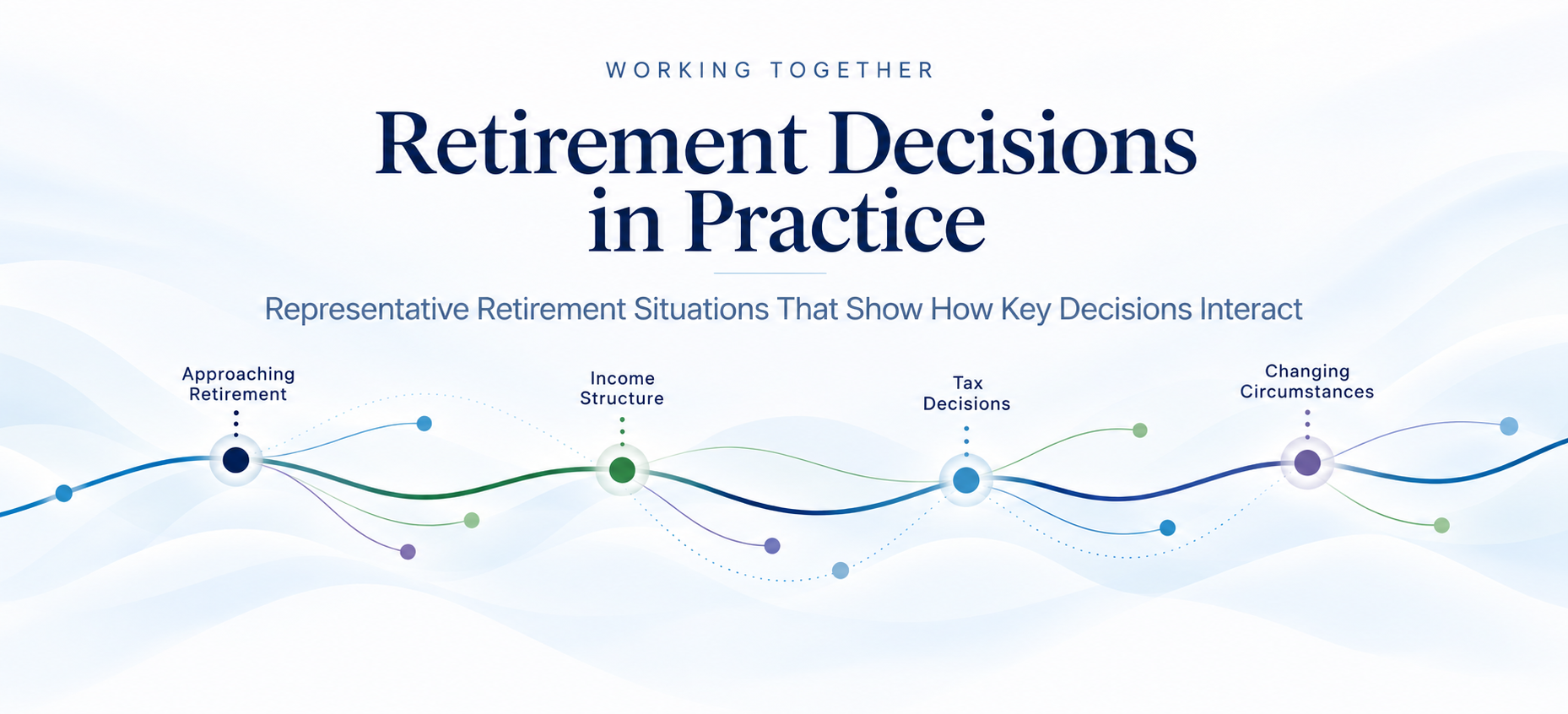
What Retirement Coordination Looks Like in Practice
Retirement often begins with a specific question.
Can we afford to retire? Which accounts should provide income first? Should we convert part of an IRA to Roth? What happens when our circumstances change?
These questions rarely stand alone. Each can lead to decisions involving spending, income, taxes, and investments.
The following examples illustrate how different retirement situations are evaluated within an ongoing advisory relationship, and why decisions may need to be reconsidered as circumstances change.
These are representative situations, not accounts of specific clients. The appropriate decisions depend on each household's circumstances.
Approaching Retirement Without a Clear Income Structure
Many people approach retirement with substantial savings but without a clear understanding of how those resources will support spending once employment income ends.
The initial work begins with spending requirements. What will the household need to support? Which expenses are ongoing, which may change, and where is flexibility available?
From there, we identify dependable income sources, evaluate when they should begin, and determine how much spending must be supported by investment assets.
Those decisions establish the context for evaluating taxes, withdrawal timing, and investment positioning.
The result is an initial retirement income structure that identifies how spending will be funded, which resources may be needed sooner, and what decisions require attention before retirement begins.
That structure becomes the starting point for ongoing review as spending, income sources, and circumstances change.
Deciding Which Accounts Should Fund Retirement Spending
A household may enter retirement with several types of investment accounts, including traditional IRAs, Roth IRAs, and taxable investment accounts.
The immediate question is often straightforward: which accounts should provide the money needed for spending?
The answer depends on more than account balances.
We first establish how much spending must be funded from investments after considering Social Security, pensions, and other income sources.
Then we evaluate the timing and sequence of withdrawals, the tax consequences of using different accounts, and the liquidity needed to support spending without unnecessary exposure to short-term market fluctuations.
These decisions also affect investment positioning. Assets expected to fund near-term withdrawals may have different responsibilities from those intended to support spending later in retirement.
As income, spending, and tax circumstances change, the withdrawal arrangement may need to change as well.
The objective is not to establish a fixed withdrawal order for the remainder of retirement. It is to maintain a process for deciding which resources should be used, when, and why.
When a Tax Decision Affects More Than Taxes
A Roth conversion may appear to be a tax question, but its consequences extend beyond the current year's tax bill.
A conversion can affect Medicare premiums, future required minimum distributions, the balance between taxable and tax-deferred resources, and the assets available to support future spending.
Before deciding whether to convert, we evaluate the household's spending needs, existing income, available resources for paying the conversion tax, and current and future tax considerations.
The analysis also considers whether a conversion may create consequences elsewhere, including higher Medicare-related costs or reduced flexibility for other income decisions.
A conversion that makes sense one year may not make sense the next. Changes in actual income, portfolio values, spending, tax law, and Medicare status can alter the tradeoffs.
The objective is not to convert as much as possible or minimize taxes in a single year. It is to determine whether a conversion is appropriate within the broader retirement structure and reassess that decision as circumstances change.
When a Surviving Spouse's Circumstances Change
A retirement income arrangement that works for a married couple may need to change after one spouse dies.
Household spending may decline, but not necessarily in proportion to the reduction in income. One Social Security benefit may end, pension income may change, and the surviving spouse may face less favorable income tax brackets.
The question is not simply whether the surviving spouse has enough assets. It is how the remaining resources should support spending under a different income and tax structure.
We revisit spending requirements, evaluate available income sources, reconsider withdrawal and tax decisions, and determine whether investment responsibilities should change.
Some adjustments may be needed immediately. Others may become relevant over the following years.
This illustrates why ongoing retirement coordination matters. An arrangement that was appropriate for one set of circumstances should not automatically be assumed appropriate for another.
Retirement Decisions Continue to Evolve
The specific questions may change, but the underlying work remains the same: understand what has changed, determine what requires attention, evaluate how one decision affects the others, and carry the agreed-upon actions forward.
That is the purpose of an ongoing advisory relationship.
If you are approaching retirement or already retired and want help coordinating the decisions that come with using your retirement resources over time, we invite you to tell us a little about your situation.
REQUEST AN INTRODUCTORY MEETING
Meeting requests are reviewed before an appointment is confirmed.