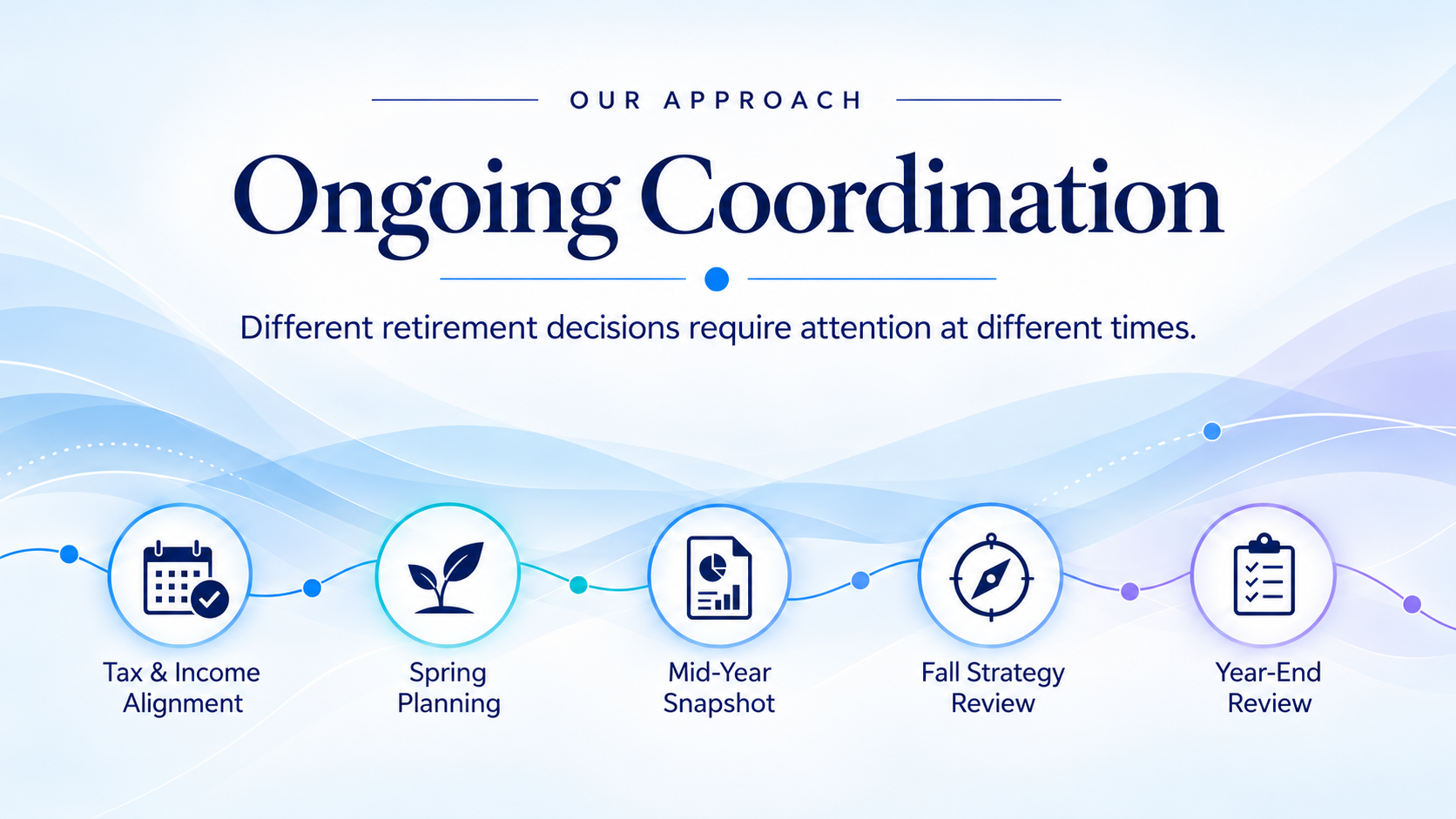
Different Retirement Decisions Require Attention at Different TimesRetirement decisions do not all need to be addressed at once. Some depend on completed tax results. Others involve current spending, income changes, investment positioning, year-end deadlines, or developments that arise as retirement progresses. Ongoing Coordination provides a recurring process for reviewing what has changed, determining which decisions require attention, and carrying agreed-upon actions forward. Each activity has a distinct purpose, while the underlying work remains connected across spending, income, taxes, and investments. Retirement decisions do not all need to be addressed at once. Some depend on completed tax results. Others involve current spending, income changes, investment positioning, year-end deadlines, or developments that arise as retirement progresses. Ongoing Coordination provides a recurring process for reviewing what has changed, determining which decisions require attention, and carrying agreed-upon actions forward. Each activity has a distinct purpose, while the underlying work remains connected across spending, income, taxes, and investments. Foundational Coordination to Ongoing CoordinationEvery Ongoing Advisory relationship begins with Foundational Coordination: Discover, the Foundational Coordination Summary, and the Investment Guide Review. This initial work establishes the household's retirement income and investment structure, along with the priorities that will guide subsequent decisions. Once Foundational Coordination is completed, Ongoing Coordination begins. The work shifts from establishing the initial structure to reviewing and adjusting it as circumstances change. Decisions and implementation actions established during Foundational Coordination remain part of the ongoing relationship. Learn About Foundational Coordination The Annual Planning Rhythm
01 — Tax & Income Alignment
Use completed tax results to inform current-year decisions. Purpose: Evaluate how prior-year tax results and current-year circumstances affect income and tax decisions. Focus:
The objective is not simply to reduce taxes in the current year, but to consider how today's decisions affect retirement income and taxes over time. We do not prepare, file, or audit tax returns. Our work focuses on tax projections, coordination with your tax preparer, and reviewing completed returns for their planning implications.
02 — Spring Planning
Establish priorities and direction for the year ahead. Purpose: Review the household's current circumstances and determine which retirement decisions require attention. Focus:
We discuss the matters that require attention, consider relevant tradeoffs, and establish priorities for the months ahead. These decisions provide the starting point for subsequent reviews as additional information becomes available.
03 — Mid-Year Snapshot
A written checkpoint on progress and changing circumstances. Purpose: Document developments since Spring Planning and identify matters requiring attention before the Fall Strategy Review. Focus:
It summarizes what has changed, what has been completed, and whether any matters require attention before the next scheduled meeting. Not every development requires a change. The Snapshot helps distinguish matters that warrant action from those that can continue to be monitored.
04 — Fall Strategy Review
Address decisions and actions that matter before year-end. Purpose: Evaluate time-sensitive retirement decisions and identify considerations for the coming year. Focus:
We evaluate how current-year income, taxes, spending requirements, and investment responsibilities interact, then identify actions to complete before applicable deadlines. We also consider known developments that may influence the following year's decisions.
05 — Year-End Recap
Document the year's work and carry forward what remains important. Purpose: Summarize the advisory work completed during the year and establish continuity into the next planning cycle. Focus:
It documents the decisions made, actions completed, and matters that remain open. The Recap also identifies information and developments that may be relevant to the next Tax & Income Alignment review, helping preserve continuity between annual planning cycles. |
A Continuing ProcessThe annual planning rhythm provides scheduled opportunities to review retirement decisions, but advisory work is not limited to those activities. Time-sensitive matters may require attention between reviews. Other decisions may remain appropriate without adjustment. Throughout the relationship, we revisit the retirement structure established during Foundational Coordination, consider new information, and determine whether changes are warranted. Ongoing Coordination provides a consistent process for deciding what needs attention, what can wait, and how earlier decisions should be adjusted as retirement circumstances change. |