
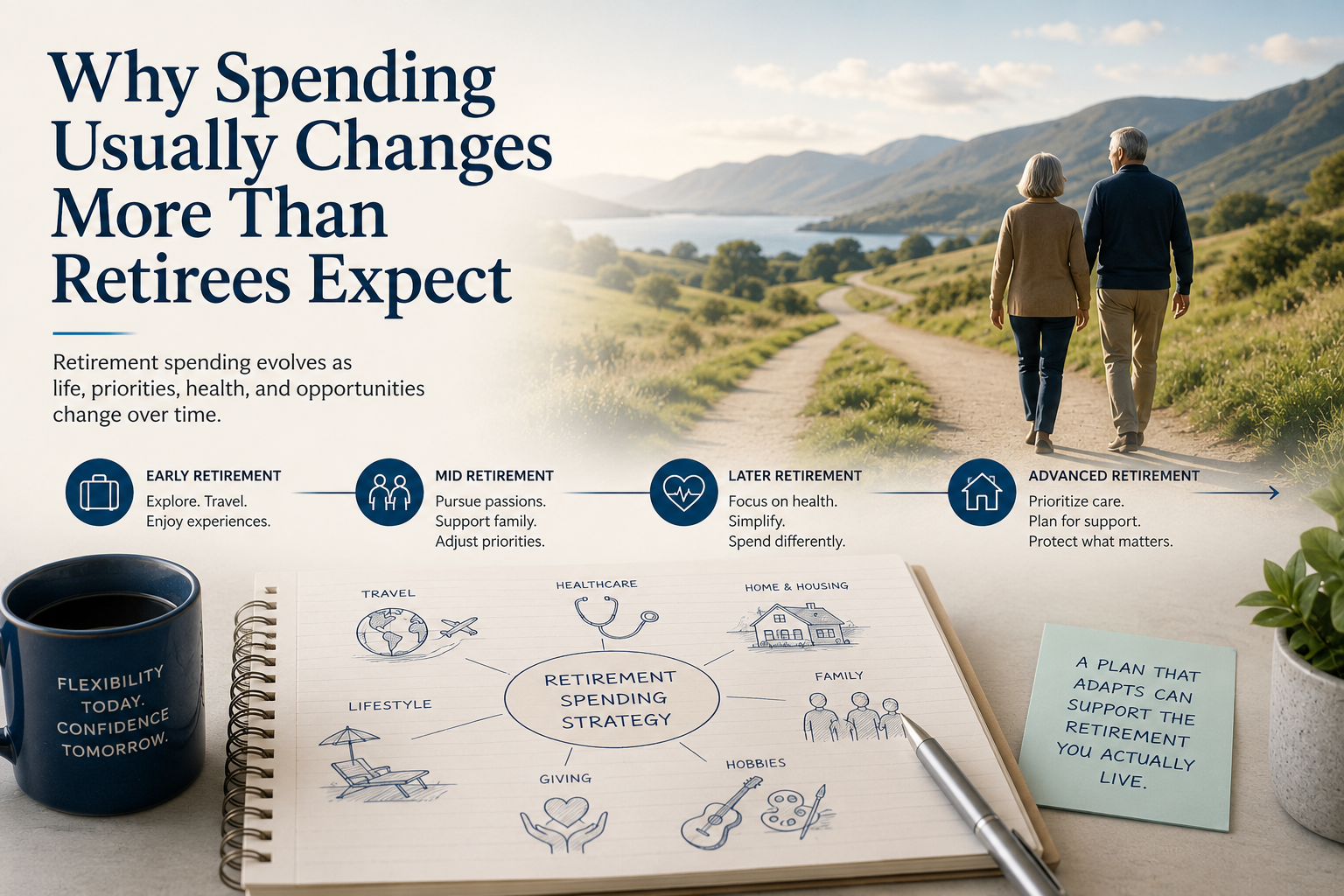
Why Spending Usually Changes More Than Retirees Expect
Retirement spending rarely remains constant because health, travel, housing, family priorities, inflation, and personal interests evolve. A flexible spending strategy is generally more realistic than assuming the same spending level throughout retirement.
Key Takeaways
- Retirement spending often changes rather than simply increases or decreases.
- Different phases of retirement usually bring different spending priorities.
- Some expenses decline while others emerge unexpectedly.
- Flexibility is often more valuable than attempting to predict every future expense.
- Spending changes influence income, taxes, and investment decisions throughout retirement.
Introduction
One of the most common assumptions in retirement planning is that spending follows a straight line.
Some people expect they'll spend the same amount every year. Others assume spending naturally declines with age.
In reality, retirement spending is rarely that predictable.
Life changes. Priorities change. Opportunities arise. Unexpected expenses occur.
Rather than trying to forecast every dollar decades into the future, a retirement spending strategy should recognize that spending is likely to evolve.
Retirement Doesn't Happen in a Single Stage
Retirement is often discussed as though it begins on the day you stop working and remains unchanged thereafter.
For many people, that's not how retirement unfolds.
The early years may include travel, hobbies, home improvements, and experiences that were postponed during working years.
Later years may shift toward spending more time close to home, supporting family members, or managing increasing healthcare needs.
These changes don't represent planning mistakes—they're simply part of life.
Some Expenses Decline While Others Increase
Not every category moves in the same direction.
Some expenses may decrease over time:
- Commuting
- Professional clothing
- Payroll taxes
- Retirement savings contributions
- Mortgage payments
At the same time, other expenses may increase:
- Healthcare
- Long-term care
- Home maintenance
- Inflation
- Assistance for children or grandchildren
- Charitable giving
- New hobbies and interests
Retirement spending often shifts from one set of priorities to another rather than steadily rising or falling.
Lifestyle Changes Are Difficult to Predict
Many of the largest retirement spending decisions are impossible to know years in advance.
You may decide to:
- Move closer to family.
- Relocate to another state.
- Purchase a second home.
- Travel more than expected.
- Travel less than expected.
- Help aging parents.
- Become more involved in charitable causes.
- Start a business or consulting work.
- Care for grandchildren.
These decisions often have significant financial implications, yet few can be predicted with certainty before retirement begins.
Inflation Changes More Than Prices
Inflation affects retirement in ways that extend beyond higher grocery bills or utility costs.
It can influence healthcare expenses, housing costs, travel, insurance premiums, and the purchasing power of your retirement income.
Over a retirement that may last 25 or 30 years—or longer—even moderate inflation can meaningfully change spending needs.
Planning for flexibility is often more effective than assuming today's expenses will simply increase by a fixed percentage every year.
Flexibility Is Often More Valuable Than Precision
It's tempting to believe that retirement planning depends on producing an accurate long-term spending forecast.
A more practical objective is creating a strategy that can adapt as circumstances evolve.
Instead of asking,
"What will I spend exactly 18 years from now?"
A better question is,
"Can my retirement plan adapt if my spending changes?"
That shift in thinking often leads to more resilient retirement decisions.
Why This Matters Within the Retirement Coordination Framework
Because spending changes over time, the remaining three pillars must remain adaptable as well.
Income may need to be adjusted.
Tax strategies may evolve.
Investment responsibilities may shift as retirement progresses.
Recognizing that spending changes allows all four pillars of the Retirement Coordination Framework to continue working together rather than becoming locked into assumptions made years earlier.
In Summary
Most retirees don't spend the same amount every year, nor do they follow a simple pattern of spending less with age. Retirement spending usually evolves as lifestyles, health, priorities, and opportunities change. Building flexibility into a retirement spending strategy helps create a framework that can adapt as retirement unfolds rather than relying on assumptions that may no longer fit.
Frequently Asked Questions
Does retirement spending usually decrease with age?
Not necessarily. Some expenses decline while others—such as healthcare, housing maintenance, or family support—may increase. For many retirees, spending changes rather than consistently decreases.
Why is retirement spending difficult to predict?
Retirement often includes unexpected lifestyle changes, evolving priorities, health needs, and inflation. These factors can significantly affect spending over time.
Should I estimate one spending number for retirement?
A starting estimate is helpful, but retirement planning should also recognize that spending is likely to evolve. Flexibility is generally more valuable than assuming one spending level will remain accurate for decades.
How does changing spending affect retirement planning?
Changes in spending influence how much income is needed, the timing of withdrawals, tax strategies, and how investments are positioned to support future needs.
Continue Learning
→ What Is a Retirement Spending Strategy?
Understand how a retirement spending strategy establishes the objective that guides retirement decisions.
→ Essential vs. Discretionary Spending in Retirement
Learn why separating essential and discretionary expenses can improve flexibility throughout retirement.
→ Why the 4% Rule Creates More Risk Than You Think
See why withdrawal rules should support your spending strategy rather than define it.
→ Income Architecture
Explore how retirement income is structured to support changing spending needs over time.