
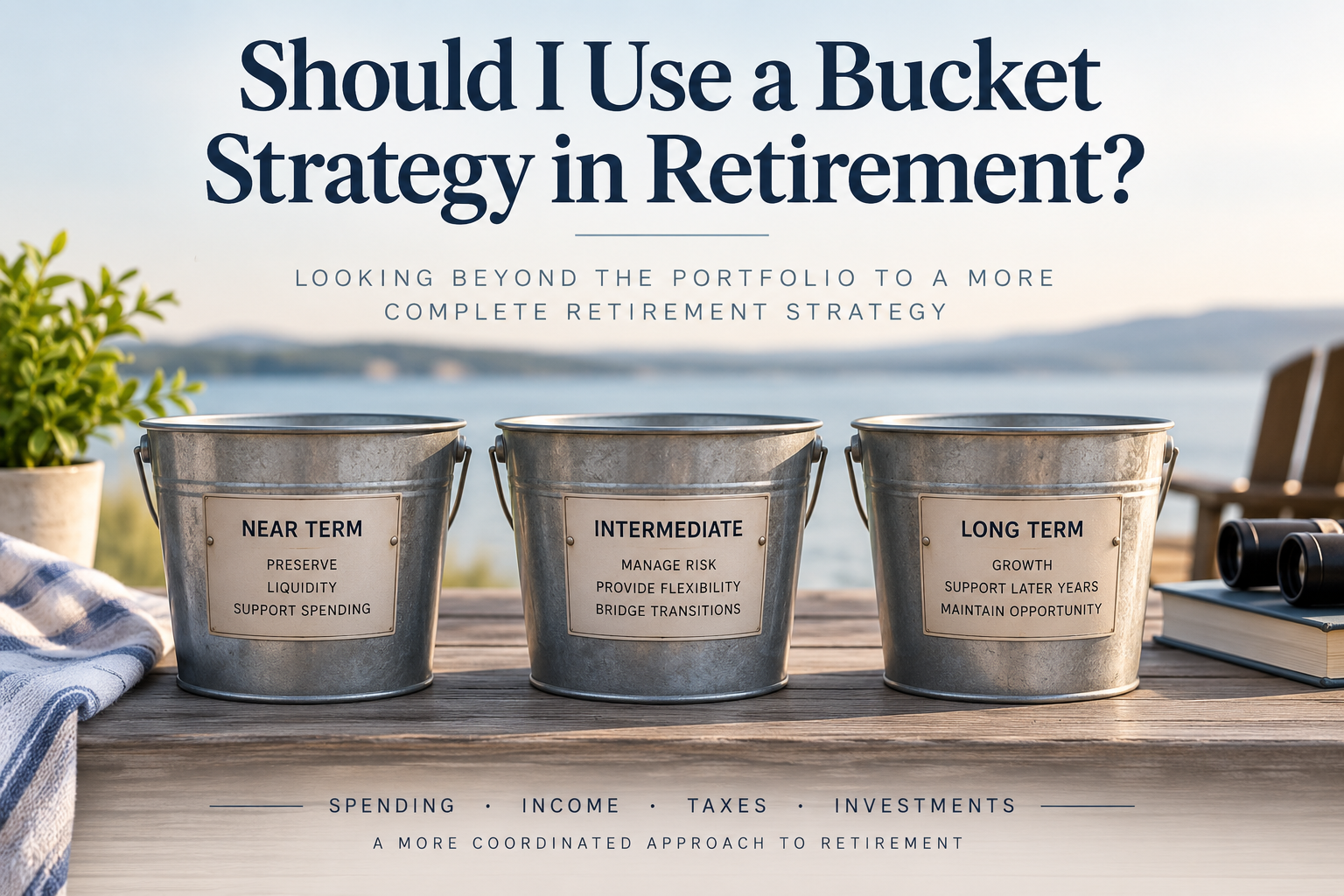
Should I Use a Bucket Strategy in Retirement?
A bucket strategy can be a useful way to organize retirement assets, but the buckets themselves do not answer the larger retirement question.
The more important question is what your investment assets are actually responsible for supporting.
That requires looking beyond the portfolio.
Retirement spending, dependable income, taxes, and investments are connected. A bucket strategy addresses part of that system, but it works best when the responsibilities of the portfolio have already been established.
What Is a Retirement Bucket Strategy?
A bucket strategy divides retirement assets into separate groups based primarily on when the money may be needed.
A common structure might include:
- A short-term bucket holding cash for near-term withdrawals
- An intermediate bucket holding bonds or other more stable investments
- A long-term bucket holding stocks for future growth
The basic idea is straightforward. Money expected to be spent soon is protected from significant market fluctuations, while money that will not be needed for many years can remain invested for longer-term growth.
This can make retirement withdrawals easier to visualize and may reduce the pressure to sell stocks during a market decline.
But there is an important question that comes before deciding how many buckets to create:
How much does the portfolio actually need to provide, and when?
Start With the Spending Requirement
Retirement income planning begins with spending.
Before deciding how much money belongs in cash, bonds, or stocks, you need to understand the spending those assets may eventually need to support.
Some spending is recurring and relatively predictable. Other expenses are discretionary, irregular, or temporary.
That distinction matters.
Suppose a household expects to spend $120,000 per year. That does not necessarily mean the investment portfolio needs to generate $120,000.
Social Security, pensions, annuity income, employment income, or other dependable sources may already support a substantial portion of that spending.
The portfolio is responsible only for the portion that remains, along with other future needs assigned to it.
This is where a traditional bucket discussion can begin too late in the process. It starts by asking how the portfolio should be divided before establishing exactly what the portfolio needs to accomplish.
Then Build the Income Architecture
Once spending requirements are understood, the next question is how those expenses will be supported.
Consider a retiree who needs $10,000 per month but receives $7,000 from Social Security and a pension.
The investment portfolio does not have a $10,000 monthly income responsibility. Its initial responsibility is closer to the $3,000 difference, plus taxes, irregular expenses, and other needs that have been identified.
That distinction can materially change how much needs to be held in short-term reserves.
Income sources also change over time.
Social Security may begin later. A pension may start at retirement. Employment income may continue for several years. Required minimum distributions may eventually provide more cash flow than the household needs for spending.
Retirement income therefore is not simply a withdrawal rate applied to a portfolio.
It is a changing combination of income sources and portfolio distributions that must support spending over time.
Taxes Affect Which Assets Should Be Used
After establishing how much income is needed, the next consideration is where that income should come from.
A dollar withdrawn from a traditional IRA can have a different tax consequence than a dollar taken from a taxable account or Roth IRA.
Withdrawals can also affect the taxation of Social Security, Medicare income-related surcharges, capital gains, and future required minimum distributions.
This creates another limitation of viewing retirement primarily through investment buckets.
Two accounts may hold similar investments but have very different tax characteristics.
A decision to refill a spending bucket is therefore not simply an investment decision. It can also be a tax decision.
The timing and source of withdrawals need to be considered alongside the investment structure.
Investments Come After Those Responsibilities Are Clear
Only after spending, income, and tax considerations have been examined can the portfolio's responsibilities be clearly defined.
Some assets may need to support spending over the next several years. Those assets generally have a different responsibility from money that is unlikely to be needed for a decade or longer.
This is where the underlying logic of bucket strategies becomes useful.
Assets with near-term responsibilities generally should not depend heavily on short-term stock market performance. Assets with longer time horizons may have greater capacity to accept market fluctuations in pursuit of longer-term growth.
But this does not necessarily require maintaining three labeled buckets.
The same principle can be incorporated into the overall investment allocation by matching assets to the responsibilities they are expected to fulfill.
The Real Issue Is Not the Number of Buckets
Retirees sometimes focus on whether they should have two buckets, three buckets, or five.
That is usually not the most important decision.
A more useful set of questions is:
What do I expect to spend?
Which income sources will support that spending, and when?
Which accounts should provide additional income given the tax consequences?
What responsibilities remain for my investments?
Once those questions are answered, the appropriate investment structure becomes easier to evaluate.
For one household, that may resemble a traditional bucket strategy. Another household may use a diversified portfolio with a defined cash reserve. Someone else may use bonds scheduled around future spending needs or combine portfolio withdrawals with guaranteed income.
The structure can differ because the responsibilities differ.
Buckets Still Require Ongoing Decisions
A bucket strategy can sometimes sound more self-maintaining than it really is.
Eventually, the short-term bucket has to be replenished.
That raises additional questions.
Should stocks be sold after a strong market year? Should bonds mature into the spending reserve? Should an IRA distribution be used? Should taxable investments be sold? Should additional cash be held because spending is expected to increase?
Those decisions cannot be settled permanently when the buckets are first created.
They depend on what has changed.
Spending changes. Income sources change. Tax circumstances change. Markets change. Required distributions begin. One spouse may eventually be managing retirement alone.
The investment structure needs to respond to those changes.
So, Should You Use a Bucket Strategy?
A bucket strategy can provide a useful structure for separating money needed relatively soon from assets intended for longer-term use.
But creating buckets should not be the starting point.
The starting point is determining what retirement spending needs to be supported. From there, dependable income can be coordinated with those spending requirements, tax consequences can influence where additional income comes from, and investments can then be positioned according to the responsibilities they need to fulfill.
That sequence is:
Spending Requirement → Income Architecture → Tax Sequencing → Investment Alignment
The distinction matters because retirement is not simply a question of how to invest a portfolio.
It is a question of how spending, income, taxes, and investments work together as circumstances change over time.
A bucket strategy may be one way to organize part of that system.
It is not the system itself.