
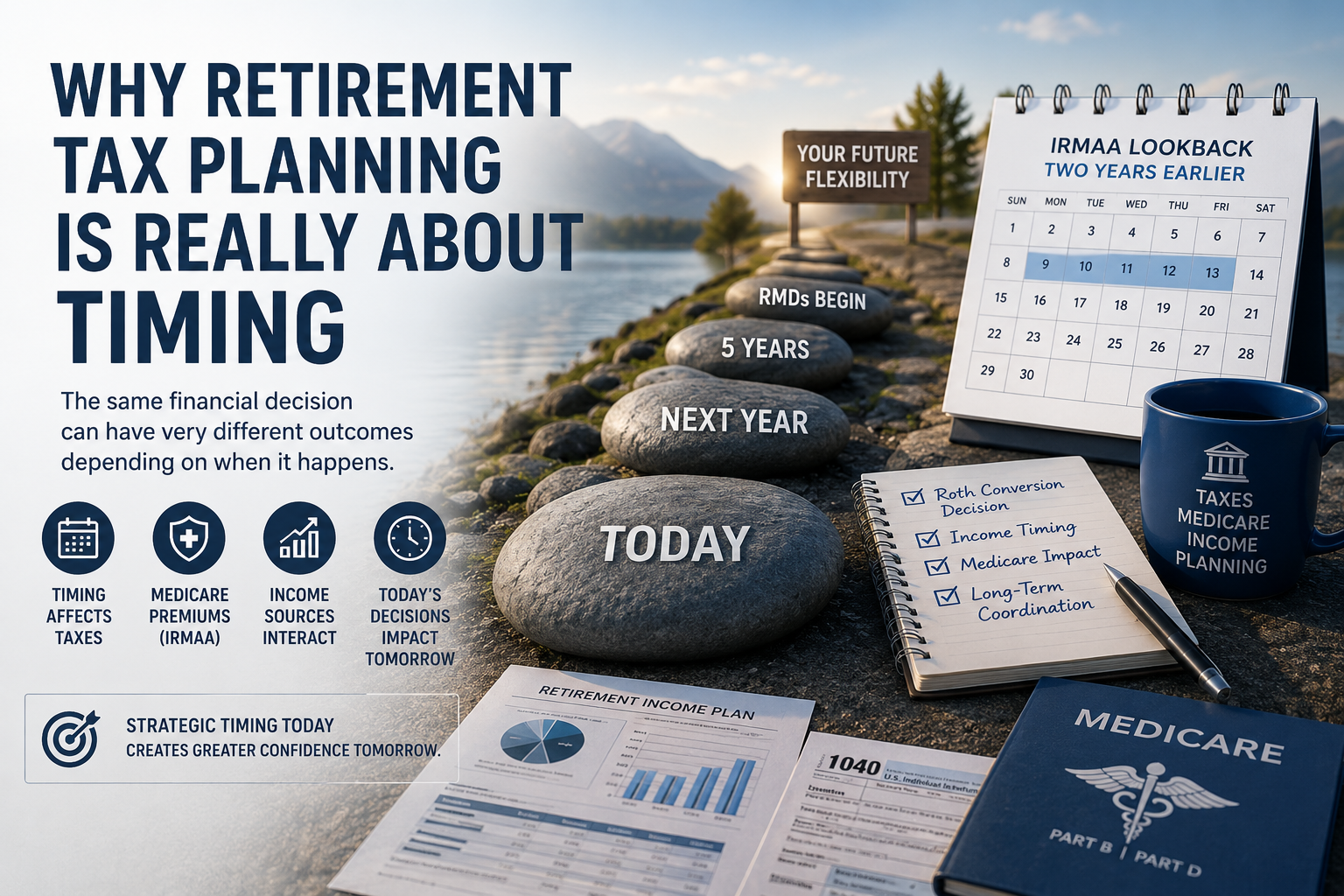
Why Retirement Tax Planning Is Really About Timing
Many people think retirement tax planning is primarily about finding ways to pay less in taxes.
In practice, retirement tax planning often becomes more about timing than tax rates alone.
The same retirement decision can produce very different outcomes depending on when income is recognized, when withdrawals begin, when Social Security is claimed, or when required distributions eventually start. Actions that appear beneficial in one year may create tradeoffs later through higher Medicare premiums, reduced flexibility, or increased taxable income during future retirement phases.
That is one reason retirement tax planning rarely functions as a single decision. Instead, it often becomes an ongoing coordination process involving income timing, healthcare costs, withdrawal sequencing, and long-term household flexibility.
Why Timing Starts Mattering More After Retirement
During working years, income tends to arrive consistently through salaries or business earnings. Taxes are often withheld automatically, and many households operate within relatively predictable income ranges from year to year.
Retirement changes that structure.
Once paychecks stop, retirees frequently gain more control over when income is recognized. Portfolio withdrawals, Roth conversions, Social Security benefits, pensions, capital gains, and required minimum distributions may all begin interacting within the same household.
That flexibility can create opportunities, but it can also create complexity.
The challenge often becomes less about avoiding taxes entirely and more about deciding when income should occur and how different income sources affect one another over time.
The Years Before Required Minimum Distributions Often Create Temporary Flexibility
Many retirees experience a transition period between leaving full-time work and beginning required minimum distributions (RMDs).
During those years, taxable income may temporarily decline. Some retirees delay Social Security benefits, reduce portfolio withdrawals, or rely more heavily on taxable savings while evaluating future income needs.
Those lower-income years sometimes create opportunities for:
- Roth conversions
- Capital gains realization
- Withdrawal coordination
- Tax bracket management
- Future Medicare premium planning
But the window does not necessarily stay open indefinitely.
Once RMDs begin, taxable income may increase again, particularly for households with large pre-tax retirement balances. What initially appeared to be a relatively low-tax retirement environment may shift substantially later.
For many retirees, timing decisions made during early retirement years can continue affecting taxes, healthcare costs, and withdrawal flexibility long afterward.
Related: How Roth Conversions Can Raise Medicare Premiums Years Later
Medicare Premiums Can Turn Timing Into a Long-Term Decision
One of the more overlooked examples of retirement tax timing involves IRMAA, the Medicare surcharge system tied to income levels.
Because Medicare premium adjustments rely on income reported from two years earlier, a large Roth conversion or capital gain today may increase Medicare Part B and Part D premiums later.
That delay often creates confusion. Retirees may experience higher Medicare costs years after the original income event occurred.
The issue is not necessarily that a Roth conversion or large withdrawal was a mistake. In some cases, paying additional premiums later may still support a broader long-term strategy. But it illustrates how retirement decisions often continue interacting long after the original transaction is complete.
Timing becomes part of the analysis because the effects rarely remain isolated within a single tax year.
Related: What Happens When One Spouse Retires Before the Other?
Retirement Income Sources Often Overlap in Unexpected Ways
Many retirees assume income naturally declines after leaving work. In practice, retirement income often becomes more layered than expected.
Different income sources may begin overlapping simultaneously:
- Social Security benefits
- Pension income
- Portfolio withdrawals
- Required minimum distributions
- Capital gains
- Part-time work
- Roth conversions
Those overlaps can temporarily increase taxable income even after full-time employment ends.
For example, one spouse may continue working while the other begins drawing retirement income. A household may delay Social Security while simultaneously completing Roth conversions. Required distributions may eventually arrive during years when healthcare costs or portfolio withdrawals are already elevated.
The complexity frequently comes from coordination itself rather than from any single income source alone.
Tax Brackets Are Only Part of the Equation
Many retirement tax discussions focus heavily on staying within certain tax brackets.
While brackets matter, they are often only one part of a much broader coordination process.
Income timing can also affect:
- Medicare premium adjustments
- Social Security taxation
- Capital gains treatment
- Withdrawal sequencing flexibility
- Survivor tax exposure
- Future required distributions
A decision that lowers taxes today may increase taxable income pressure later. Alternatively, paying taxes earlier through Roth conversions may reduce future withdrawal constraints or survivor tax exposure down the road.
Retirement tax planning, therefore, becomes less about minimizing taxes in every individual year and more about managing tradeoffs across multiple retirement phases.
Household Transitions Can Change Future Tax Exposure
Retirement tax planning also changes as household circumstances evolve.
One of the most significant shifts often occurs after the death of a spouse.
A surviving spouse may continue managing substantial retirement account balances and required distributions while filing taxes as a single taxpayer. That transition can compress tax brackets and increase future Medicare-related income exposure even if overall household income declines.
In some cases, couples evaluate Roth conversions or withdrawal strategies partly to reduce future pressure on the surviving spouse later in retirement.
Again, timing becomes central because decisions made years earlier may affect flexibility long after household circumstances change.
Why Retirement Tax Planning Rarely Stays Static
Many retirees revisit tax decisions repeatedly over time because retirement itself continues evolving.
Markets fluctuate. Spending changes. Healthcare costs rise. Tax laws eventually adjust. Portfolio balances shift. Household priorities evolve.
As a result, retirement tax planning rarely functions as a one-time optimization exercise.
A strategy that appeared effective during lower-income years may look very different after required distributions begin or after healthcare costs increase. Similarly, decisions that once seemed unnecessary may later become more attractive as retirement unfolds.
The ongoing challenge is not simply reducing taxes. It is coordinating how income, withdrawals, healthcare costs, and long-term flexibility interact over time.
People Also Ask
Why is timing important in retirement tax planning?
Timing affects when income becomes taxable and how different retirement income sources interact. Decisions involving Roth conversions, withdrawals, Social Security, and required minimum distributions may continue affecting taxes and Medicare costs years later.
What is the best time for Roth conversions in retirement?
Many retirees evaluate Roth conversions during lower-income years after leaving work but before required minimum distributions begin. The ideal timing depends on future income expectations, Medicare considerations, and long-term tax planning goals.
How do RMDs affect retirement taxes?
Required minimum distributions increase taxable income once they begin. Larger pre-tax retirement balances may eventually push retirees into higher tax brackets or increase Medicare-related premium adjustments.
Can retirement taxes increase later in retirement?
Yes. Taxes may increase later due to required distributions, survivor filing status changes, Social Security taxation, portfolio withdrawals, Medicare income-related adjustments, or changes in tax policy.
Why do retirees revisit tax strategies over time?
Retirement circumstances rarely remain fixed. Income levels, spending needs, healthcare costs, market conditions, and tax laws often change throughout retirement, requiring ongoing adjustments.
How does one spouse's retiring early affect taxes?
Staggered retirement can create overlapping income sources, with one spouse continuing to earn wages while the other begins withdrawals or retirement income planning. That overlap may temporarily increase tax coordination complexity.
Conclusion
Retirement tax planning is often framed as a search for lower tax rates or larger deductions.
In practice, the larger challenge is frequently timing.
Income decisions made today may influence Medicare premiums years later. Withdrawal strategies can affect future flexibility. Required distributions may reshape taxable income later in retirement. Household transitions can alter long-term tax exposure unexpectedly.
What matters is not only how much income retirees recognize, but also when different financial systems begin interacting with one another.
That is why retirement tax planning often becomes less about isolated tax decisions and more about coordinating multiple moving parts across retirement over time.