
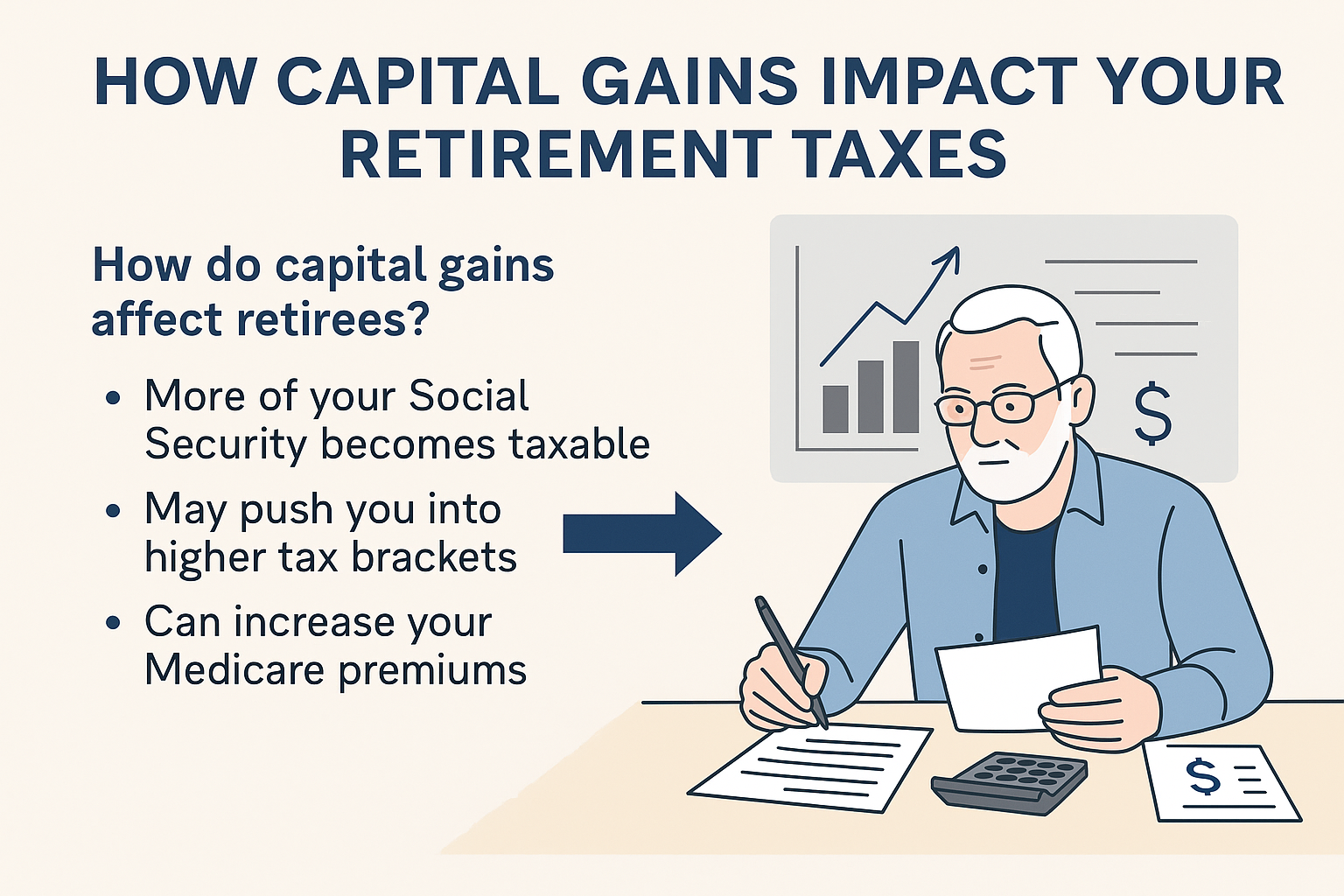
How Capital Gains Impact Your Retirement Taxes
Realized capital gains in retirement can increase your taxable income, potentially pushing you into a higher tax bracket, increasing the taxation of your Social Security
Q: How do capital gains affect retirees?
A: Selling appreciated investments in taxable accounts can trigger capital gains taxes. While long-term gains are taxed at 0%, 15%, or 20%, their ripple effects can reach farther:
- They can cause more of your Social Security to become taxable.
- They may push you into higher tax brackets.
- They can increase your Medicare premiums via IRMAA.
- They can subject you to the Net Investment Income Tax (NIIT)
Types of Capital Gains and How They’re Taxed
- Short-term gains: Taxed as ordinary income (less favorable).
- Long-term gains: Taxed at preferential rates, but may still raise your overall tax picture.
Hidden Costs of Poorly Timed Sales
A large gain can:
- Increase your taxable income suddenly.
- Push you over the IRMAA thresholds for Medicare.
- Trigger higher taxes on Social Security benefits.
- Exposes you to NIIT
Real Example – How a Portfolio Rebalance Spiked Taxes
A Portland retiree rebalanced her portfolio and unintentionally realized $80,000 in long-term gains. That year:
- 85% of her Social Security became taxable.
- She hit a higher IRMAA bracket.
- Her effective tax rate jumped despite her “low” income.
We helped create a strategy to spread future gains and use tax-loss harvesting.
Tax-Smart Strategies to Manage Capital Gains
1. Harvest Gains Strategically
- Spread large sales over multiple years
- Use 0% capital gains bracket if available
2. Offset with Losses
- Use tax-loss harvesting to neutralize gains
3. Time Social Security Carefully
- Delay benefits if large gains will spike income
4. Use Roth Accounts and QCDs
- Avoid generating taxable income when possible
Conclusion: Capital Gains Are Manageable—With the Right Strategy
You don’t have to avoid capital gains—but you do need to plan for them.
As a Portland-based advisor focused on retirement income and tax planning, I help clients build withdrawal strategies that protect both income and healthcare costs.
Your complimentary RISA can help clarify how much flexibility your income plan needs—and how capital gains may fit in.
FAQs
Q: Do all capital gains affect my Medicare premiums?
A: Only if they increase your MAGI above IRMAA thresholds. It’s the cumulative income that matters.
Q: Is it better to sell appreciated assets before or after starting Social Security?
A: Often before. That way, your Social Security benefit stays untaxed while your income is higher.
Q: Can I control when gains are realized?
A: Yes. Unlike dividends, capital gains aren’t taxed until you sell—so timing is key.