
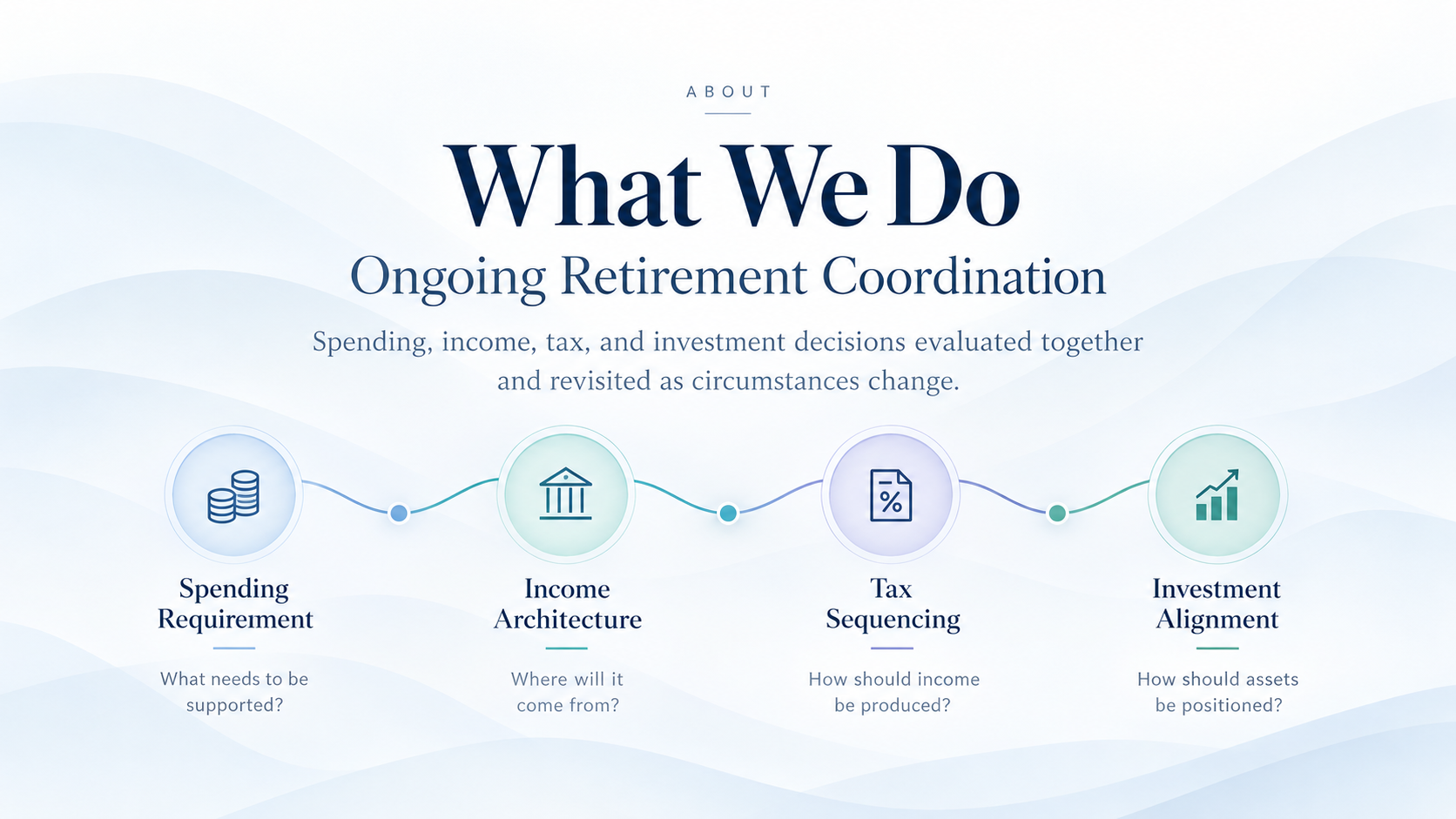
What We Do
We help people approaching retirement and those recently retired make decisions about how their retirement resources should support spending over time.
That work includes determining where income should come from, evaluating tax consequences and timing, and aligning investments with the responsibilities they are expected to fulfill.
Rather than addressing these decisions independently, we evaluate how they affect one another and revisit them as circumstances change.
What We Coordinate
Spending Requirement
What needs to be supported?
We begin with the spending your retirement resources need to support, including ongoing living expenses and larger or less frequent needs that may arise over time.
Income Architecture
Where will it come from?
We coordinate Social Security, pensions, cash reserves, portfolio withdrawals, and other available resources to determine how spending will be funded.
Tax Sequencing
How should income be produced?
We evaluate withdrawals, Roth conversions, capital gains, required minimum distributions, Medicare-related thresholds, charitable giving, and other tax-sensitive decisions across multiple years.
Investment Alignment
How should assets be positioned?
We align investment decisions with the spending, income, tax, and liquidity responsibilities each account is expected to support.
Then add:
Explore the Retirement Coordination Framework
How the Work Continues Throughout the Year
The initial coordination work establishes the starting point, but retirement decisions continue to change over time.
Our annual planning rhythm provides regular points to review what has changed, address decisions that require attention, carry agreed-upon actions forward, and revisit earlier decisions when circumstances change.
Tax & Income Alignment Review
Uses completed tax results to inform current-year income and tax decisions.
Spring Planning
Reviews spending, income, taxes, and investments and establishes direction for the year ahead.
Mid-Year Snapshot
Provides a written checkpoint on what has changed, what has been completed, and what may require attention.
Fall Strategy Review
Addresses time-sensitive year-end decisions and considerations for the coming year.
Year-End Review
Summarizes the advisory work completed during the year and identifies matters carrying into the next planning cycle.
Retirement coordination is not about answering every future question today. It provides a structure for addressing decisions when they become relevant and revisiting earlier decisions as new information emerges.