Most retirement advice treats income, investments, taxes, and claiming decisions as separate problems.
In practice, retirement income doesn’t work that way. These decisions interact continuously, and when they’re handled in isolation, the result is often unnecessary tax friction, unstable cash flow, and plans that look sound on paper but struggle as life and markets change.
Our work is built around retirement income coordination—helping clients understand how income sources, portfolio structure, and tax decisions work together over time, and how to make thoughtful adjustments as circumstances evolve.
The Retirement Income Coordination Framework
Retirement income is not a single decision or a one-time calculation. It is an ongoing coordination problem.
Our framework focuses on how income, investments, and taxes interact across retirement—rather than optimizing any one decision in isolation. The goal is to support sustainable spending, flexibility, and clarity, even as markets, tax rules, and personal priorities change.
This coordination-first approach mirrors the way retirement actually unfolds, rather than forcing real-world decisions into static planning assumptions.
How We Work
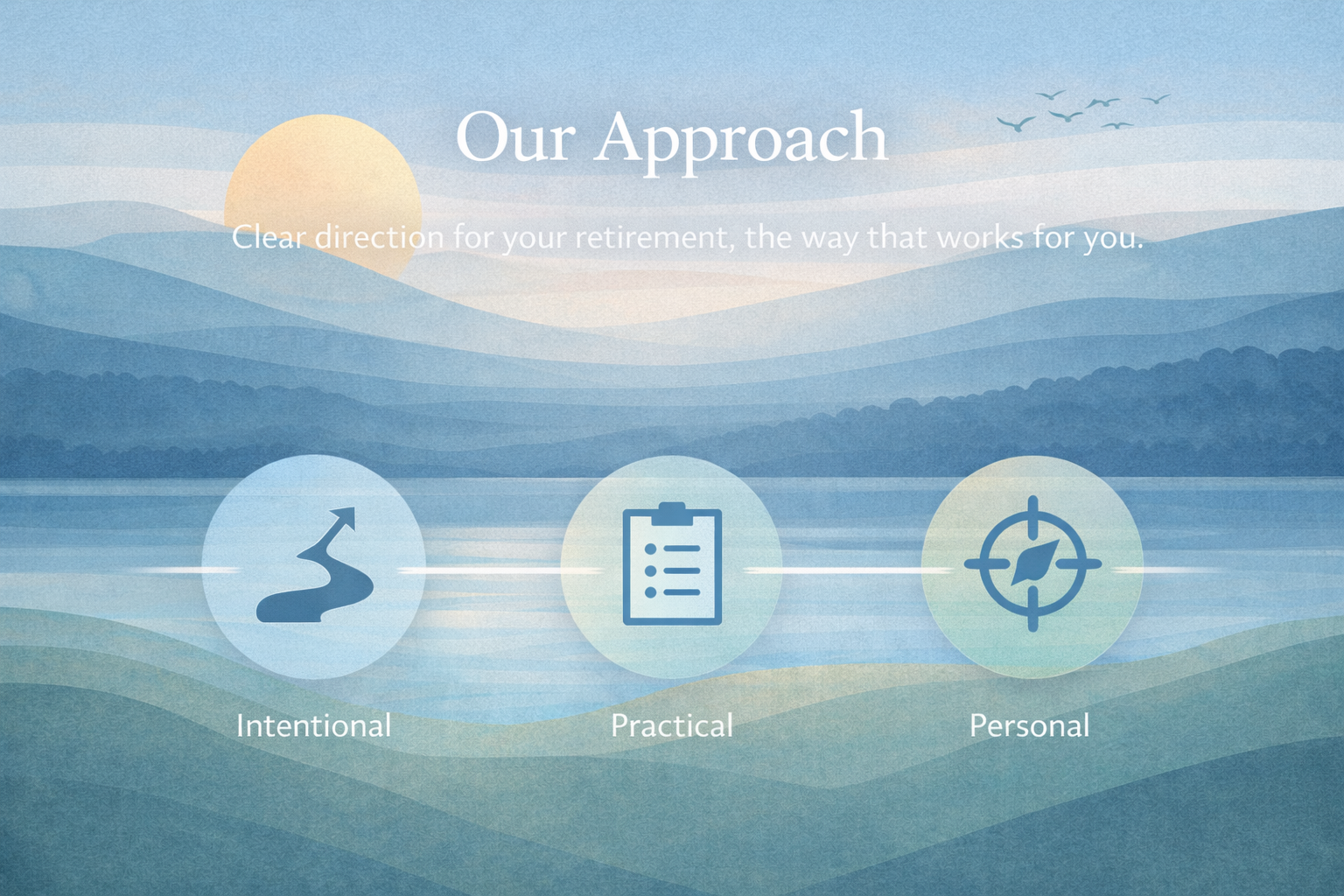
We help clients make coordinated retirement income decisions over time, with an emphasis on judgment, trade-offs, and adaptability rather than prediction or precision.
Rather than producing a static plan, our work focuses on:
- understanding what your resources can realistically support,
- clarifying the trade-offs between competing decisions,
- and adjusting thoughtfully as conditions change.
This approach reflects the reality that retirement decisions are revisited over time—not solved once and left untouched.
Investments as One Part of the Income System
Investments matter in retirement—but only in the context of the income they are meant to support.
We use disciplined, evidence-based investment strategies, but portfolio decisions are made in coordination with:
- income timing,
- withdrawal strategy,
- spending needs,
- and tax considerations.
The objective is not to outperform markets, but to support a reliable, flexible income framework that holds up across different environments.
Coordinating Income and Spending Over Time
In retirement, the outcome is income—and that’s where we focus.
We help clients understand how different income sources work together, how withdrawals affect both cash flow and taxes, and how spending decisions influence long-term sustainability. The emphasis is on designing income flows that support consistency early in retirement while preserving flexibility later on.
Rather than predicting exact outcomes, we focus on building an income structure that can be adjusted thoughtfully as circumstances change.
Taxes as a Coordination Constraint, Not a Separate Exercise
Taxes influence how much income you keep and how long your resources can support retirement.
Instead of treating taxes as a once-a-year task, we integrate tax considerations into income and investment decisions throughout retirement. This includes evaluating:
- where assets are held,
- how withdrawals are sequenced,
- and how decisions today affect flexibility later on.
The goal is not short-term tax optimization, but long-term adaptability in an environment where future rules are unknowable.
Why This Approach Is Different
Many retirees are well served during accumulation by goal-based or optimization-driven planning. Retirement introduces a different challenge.
Income decisions are interconnected, uncertainty matters more than precision, and flexibility often matters more than maximizing any single outcome. Our coordination-first approach is designed specifically for this phase—helping clients make informed decisions, understand trade-offs, and move forward with confidence.